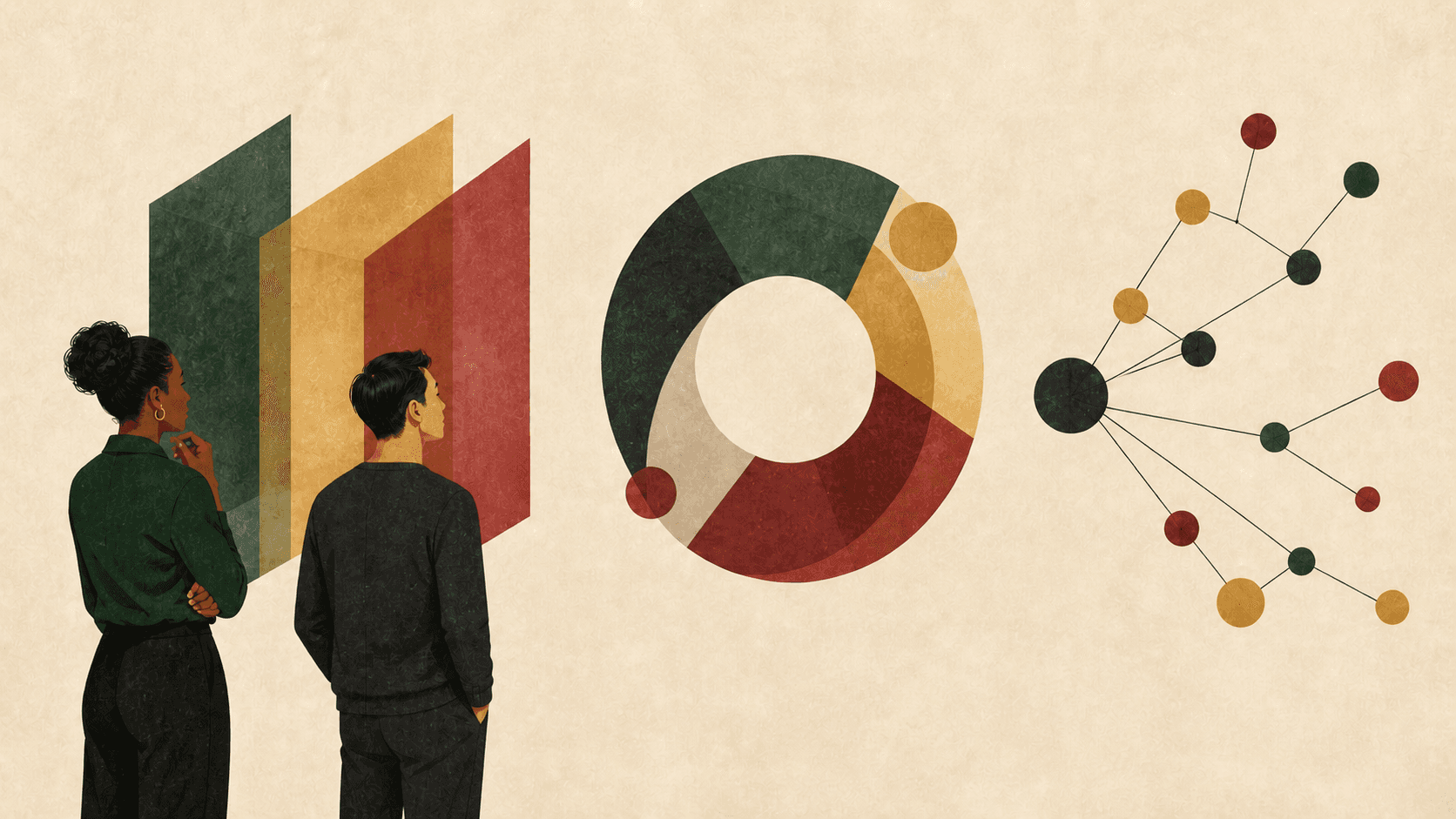
Hero's Journey Map: Free 12-Stage Template & Diagram
The hero's journey is a circle of 12 mirrored stages, not a checklist. See the full map and diagram, then adapt the free template to your story.
By Elias Ward
Founding writer at Scyn
Key takeaways
- The hero's journey is a spatial, circular structure where stages mirror each other across the arc, not a sequential checklist.
- The twelve stages group into four movements: the Known World, the Threshold Crossing, the Unknown World, and the Return.
- Mapping the journey as a node network with causal edges reveals structural relationships that numbered lists and circle diagrams both hide.
- Not every story needs all twelve stages; what matters is understanding the narrative function each stage serves and keeping the ones your story requires.
- The template adapts across genres, from fantasy and coming-of-age to thriller and horror, though the emotional signs on each stage may change.
Most writers encounter the hero's journey as a numbered list. Twelve stages, stacked vertically, implying that the structure is a straight line from stage one to stage twelve. It is not. The monomyth is a circular, spatial structure where stages echo each other across the arc, where the beginning and end deliberately mirror one another, and where meaning comes from the relationship between stages as much as from any single stage itself.
The free hero's journey template turns that circle into an editable map. Use it to place your story on the twelve stages, then connect the choices and consequences that make the stages matter.
A list cannot show you any of that.
12-stage hero's journey map at a glance
| Stage | Movement | Concise example |
|---|---|---|
| 1. Ordinary World | Known World | Luke on Tatooine; Frodo in the Shire |
| 2. Call to Adventure | Known World | Leia's message; Gandalf arrives with the ring |
| 3. Refusal of the Call | Known World | Duties, fear, or disbelief delay commitment |
| 4. Meeting the Mentor | Known World | Obi-Wan, Gandalf, or another guide equips the hero |
| 5. Crossing the Threshold | Hinge | Leaving home after the cost becomes real |
| 6. Tests, Allies, Enemies | Unknown World | Learning the new rules with help and opposition |
| 7. Approach to the Inmost Cave | Unknown World | Planning the central confrontation |
| 8. The Ordeal | Unknown World | Symbolic death, failure, or maximum danger |
| 9. Reward | Unknown World | Knowledge, power, or proof of change |
| 10. The Road Back | Return | Turning toward home with unfinished pressure |
| 11. Resurrection | Return | Final public test of the transformation |
| 12. Return with the Elixir | Return | Bringing something home that changes the world |
Use this table as a one-screen map. The sections below keep the longer examples and the causal relationships between stages.
Free hero's journey diagram, PNG download, and print-to-PDF
Looking for a free hero's journey map PDF or diagram? The asset below is a PNG network diagram of the journey, not a multi-page form-fill PDF. Download it, embed it with attribution, or open it and use your browser's print dialog to save as PDF.
For an editable free template rather than a static diagram, open the interactive hero's journey template.
Why is the hero's journey not a checklist?
The numbered list format does something subtle and damaging: it makes each stage look independent. Complete stage one, move to stage two. Check off Meeting the Mentor, advance to Crossing the Threshold. This reading treats the hero's journey the same way a recipe treats ingredients. Add them in order and you will get the result.
But Campbell's insight was not about sequence. It was about transformation through opposition. The Ordinary World exists to be shattered. The Return only carries weight because we remember what was left behind. The Ordeal is not a midpoint event; it is the gravitational center that every stage before it approaches and every stage after it radiates from.
When you understand the hero's journey spatially, the template stops being a checklist and becomes a map of psychological movement. The hero travels away from everything familiar, reaches a point of maximum danger and transformation, and returns carrying something that changes the world they left. The shape of that movement matters. The relationship between departure and return is the story.
What are the 12 stages as a spatial map?
Before breaking down the stages into clusters, it helps to think about where they sit relative to one another. The journey divides cleanly into four movements, and the boundary between the first and second is the most important threshold in the story.
The Known World (Stages 1-4)
Stages one through four all take place before the hero has truly committed to change. They establish what will be lost and what needs to be left behind.
Stage 1: Ordinary World. Luke Skywalker on Tatooine. Frodo in the Shire. Simba as a cub, playing on Pride Rock without knowing what lurks beneath it. The Ordinary World is not just setting. It is the baseline against which the entire story will be measured. Everything the hero eventually gains or loses is defined by this opening.
Stage 2: Call to Adventure. Something breaks the stasis. A message arrives, a death occurs, a danger appears. For Luke, it is the holographic message from Leia inside R2-D2. For Frodo, Gandalf arrives with the ring and its history. The call is never just an external event; it is an offer to become someone different.
Stage 3: Refusal of the Call. The hero hesitates. Luke says he cannot leave, he has responsibilities. Frodo genuinely tries to pass the ring to Gandalf. This stage is often misread as simple cowardice, but it is actually an honest acknowledgment of the cost. Crossing the threshold means losing the Ordinary World. Refusal is the hero taking that cost seriously.
Stage 4: Meeting the Mentor. Obi-Wan appears. Gandalf reveals the full scope of what is at stake. Rafiki shows Simba his reflection and his father's face in the stars. The mentor does not solve the hero's problem. The mentor gives the hero what they need to face it. Then the mentor either leaves, is taken away, or steps back.
These four stages form a cluster on the map. They are causally linked, each one setting up the next, and together they establish everything the second half of the journey will complicate.
Crossing the Threshold (Stage 5)
This is the hinge of the entire structure. The hero commits.
Luke leaves Tatooine after his aunt and uncle are killed. There is nothing left in the Ordinary World to return to, and the decision is made. Frodo crosses out of the Shire, past the boundaries of everything familiar. Simba, after years of exile, accepts that he must return.
The threshold crossing deserves its own position on any visual map of the hero's journey because it is genuinely different from everything before and after it. Before it, the hero can turn back. After it, the story changes shape. The question shifts from "will the hero answer the call?" to "will the hero survive what the call demands?"
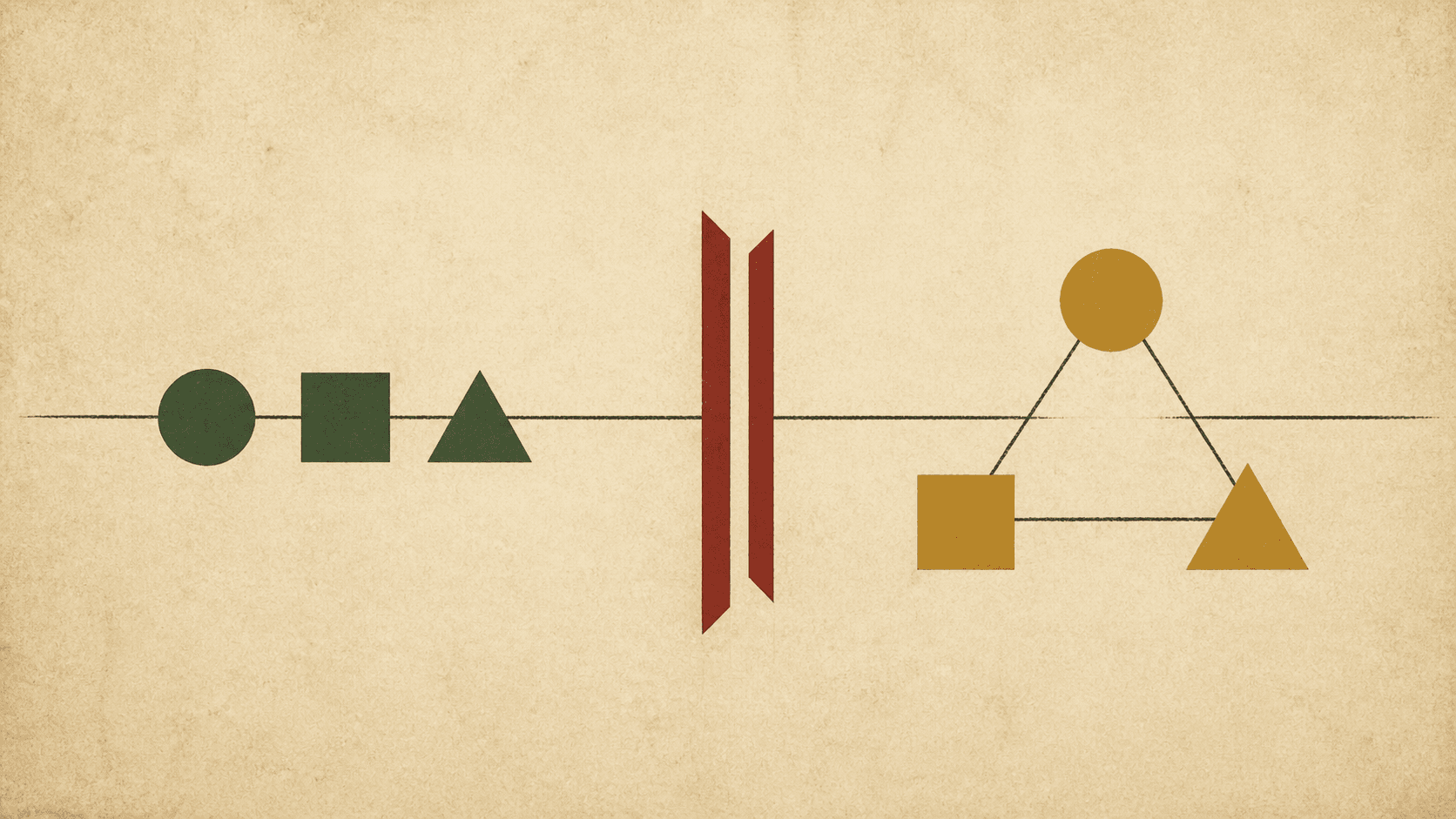 Crossing the threshold. The known world on the left is orderly and sparse. The unknown world on the right is denser and more interconnected. Once the hero crosses, the structure of the story changes.
The Unknown World (Stages 6-9)
Stages six through nine take place entirely in unfamiliar territory, governed by rules the hero does not yet understand. This is the bulk of the second act.
Stage 6: Tests, Allies, Enemies. The hero learns the landscape of the new world. Luke meets Han and Chewbacca, learns what the Rebellion is up against, discovers that the Death Star exists. Frodo meets Aragorn in Bree, is chased by the Ringwraiths, and arrives at Rivendell where he encounters the full weight of Middle-earth's politics. This stage is exploratory. The hero is not yet ready for the central challenge.
Stage 7: Approach to the Inmost Cave. The hero prepares, often through a period of planning or gathering. The team assembles. The plan is laid out. For Luke, this is the Rebel briefing before the assault on the Death Star. For Frodo, the Fellowship forms and departs. The approach is defined by knowing what lies ahead and choosing to move toward it anyway.
Stage 8: The Ordeal. The central crisis. The hero faces their greatest fear, fails, nearly dies, or undergoes a symbolic death. Luke faces Darth Vader. Simba confronts Scar and the truth about Mufasa's death. Frodo, at the Cracks of Doom, fails and loses the ring to his own will before Gollum inadvertently completes the quest. The hero does not necessarily triumph here. They survive. The ordeal breaks something and the hero is changed by what breaks.
Stage 9: Reward. The hero gains something from surviving the ordeal. A weapon, a piece of knowledge, a deeper understanding of themselves. Luke learns to trust the Force. Frodo destroys the One Ring and the threat is gone. Simba reclaims his identity and his throne. The reward is never just a physical object. It is proof that the hero has been transformed.
The Return (Stages 10-12)
The final three stages are a mirror of the first three. The hero must bring what they have gained back to the world they left.
Stage 10: The Road Back. The hero turns toward home. Frodo and Sam make their way out of Mordor. Simba returns to Pride Rock. This stage often includes a final chase or delay, a reminder that the old world is not simply waiting in place. It has changed too.
Stage 11: Resurrection. A final test near the end of the journey, after which the hero is truly reborn. Frodo sailing to the Undying Lands is a form of this, a surrender of the ordinary life he fought to protect. Simba claiming the throne and the rain returning to Pride Rock. The resurrection is the public proof of private transformation.
Stage 12: Return with the Elixir. The hero brings something back that heals or changes the world they left. Sam returns to the Shire with stories, experience, and eventually a family. Luke rebuilds the Jedi. Simba restores Pride Rock to life. The elixir is whatever the hero gained that now belongs to others.
Why is a circle diagram not enough?
The circle diagram is the most common visual representation of the hero's journey, and it is more useful than a list. It shows the cyclical structure, the connection between departure and return, and the sense that the hero ends somewhere close to where they began but transformed.
But it obscures two things that matter.
First, the stages are not evenly spaced around the circle. The Ordeal is not simply "the bottom" of the cycle; it is the gravitational center. Everything before it gains meaning from what it leads to. Everything after it takes its meaning from what was paid to get here. The stages are weighted differently, and equal spacing suggests they carry equal narrative mass.
Second, the circle collapses the branching structure. At nearly every stage, the hero faces a genuine choice. Refuse the call and the story ends. Skip the mentor and the approach becomes blind. Stages have alternates, shortcuts that weaken the story, and paths that lead to different kinds of ordeal. A circle cannot show any of that.
How do you map the journey as a node network?
The hero's journey mapped as a node network, rather than a list or a circle, reveals the structural relationships that neither format can show.
Nodes as Story Beats
Each of the twelve stages becomes a node on the canvas. But unlike a list, nodes on a map have position. The Ordinary World sits at one end. The Return with the Elixir sits at the other. The Ordeal occupies a central position with more connections flowing into and out of it than any other stage.
You can also add nodes that are not the twelve canonical stages. The mentor's departure is not its own stage in most templates, but it is a significant beat that connects Stage 4 to Stage 5. Adding it as a node makes the causal chain explicit. The hero goes from "has a guide" to "must proceed alone," and seeing that as a connection changes how you write the scene.
Edges as Cause and Effect
A line between two nodes on a hero's journey map should represent a causal or thematic link, not just sequence. The Refusal of the Call does not just precede the Mentor; it creates the psychological pressure that makes the mentor necessary. The Ordeal does not just precede the Reward; surviving the ordeal is what earns it.
Drawing these connections forces precision. You cannot draw a line from Stage 3 to Stage 9 without asking what that line represents. If the hero's refusal in the first act never comes back to haunt them in the ordeal, there is no line to draw. If it does, the line is the whole point.
Scyn's hero's journey template is built for this kind of mapping. Lay out the twelve stages as nodes on a canvas, draw explicit causal edges between them, and then map your specific story against that scaffold. You will see where your story aligns, where it diverges, and where the structural relationships are missing.
For a complementary cause-and-effect reading — including a dead-link checklist that tests whether each stage forces the next — see the cause-and-effect map guide. It does not replace this long guide.
Clusters as Act Boundaries
When you map the journey as a network, three clusters emerge naturally. The Known World cluster (Stages 1-4) groups tightly because each stage feeds the next with minimal branching. The Unknown World cluster (Stages 6-9) is denser and more interconnected, with tests and allies feeding back into preparation. The Return cluster (Stages 10-12) mirrors the Known World cluster but with reversed emotional valence.
The threshold crossing and the ordeal sit between clusters, not within them. They are the hinges. A visual map makes this visible in a way that a numbered list or a circle cannot.
Explore the hero's journey as an interactive plot map. Twelve stages laid out spatially with structural mirrors between departure and return. See what connects to what.
What should you keep and what should you cut?
The hero's journey is a descriptive framework, not a prescriptive one. Campbell observed patterns across thousands of myths and stories. He was not handing down a formula. Knowing which stages are load-bearing and which are optional changes how you use the template.
Stories That Fit Naturally
Transformation stories fit the hero's journey most naturally, specifically stories where the protagonist must become someone different in order to solve the central problem. Coming-of-age narratives, adventure stories, and stories about confronting inherited trauma all sit in this category.
Star Wars fits because Luke's journey is fundamentally about accepting his identity and his power. The Lord of the Rings fits because Frodo's journey is about carrying a burden that would break anyone, and surviving it. The Lion King fits because Simba's journey is about refusing responsibility and then accepting it.
What these have in common: the hero at the end is recognizably different from the hero at the beginning, and the story exists to enact that transformation.
Stories That Need Modification
Anti-hero stories and ensemble narratives both need modification. An anti-hero who does not transform cannot follow the classical arc, because the arc is defined by transformation. You can use the spatial structure while inverting the emotional valence. The anti-hero crosses the threshold, survives the ordeal, and returns with an elixir, but what they bring back might be destructive rather than healing. The map looks the same. The meaning is inverted.
Ensemble stories can run parallel hero's journeys, one per major character, with explicit connections between the arcs. On a node network, this becomes visible as separate clusters connected at specific points, characters whose journeys intersect at the threshold, or whose ordeals are linked.
Stages You Can Skip
Meeting the Mentor is optional. Many protagonists develop without explicit guidance from a senior figure. What is not optional is whatever function the mentor serves: giving the hero what they need to face the unknown world. That function must be served somehow, whether by a character, an event, or a piece of knowledge. The stage label is optional. The narrative function is not.
The Refusal of the Call is often abbreviated or removed in action-oriented stories where early momentum matters more than psychological realism. The Road Back and Resurrection are frequently collapsed into a single climactic sequence. The shape of the map changes when you compress stages, but the essential clusters remain: Known World, crossing, Unknown World, return.
How does the hero's journey apply across genres?
Fantasy and Adventure
Fantasy and adventure stories are where the monomyth fits most comfortably. The Unknown World is often literally unknown: a new land, a magical realm, a frontier. The threshold crossing is geographic as well as psychological. This makes the spatial structure easy to visualize and straightforward to map.
The risk in fantasy and adventure is that the outer journey (the physical quest) overshadows the inner journey (the transformation). If Luke destroys the Death Star but remains psychologically unchanged, the story has the shape of the hero's journey without its substance. The outer quest and the inner quest should be causally linked. The reason Luke can destroy the Death Star is because he has changed enough to trust the Force over his targeting computer.
Coming-of-Age and Drama
In coming-of-age stories, the Unknown World is often social or psychological rather than geographic. The threshold crossing is a moment of no-return in terms of knowledge or experience, not necessarily a physical departure. The ordeal is often an internal one, a confrontation with identity, shame, or loss.
The hero's journey maps cleanly onto coming-of-age narratives because the genre is, by definition, about transformation. The challenge is that the elixir brought back tends to be intangible, wisdom, maturity, acceptance. On a node map, this means the edges in the Return cluster carry thematic weight that needs to be made explicit in the scene work itself.
Thriller and Horror
Thrillers and horror stories often use an inverted hero's journey, where the crossing of the threshold is an unwilling one. The protagonist does not answer a call; they are pulled or forced across. The mentor is often absent. The Unknown World is actively hostile in ways that go beyond tests and obstacles.
In horror especially, the Resurrection stage is where genre conventions operate: surviving the final attack of the monster, escaping the house, emerging from the water. The question of what elixir is brought back is often grim. The protagonist knows something they cannot un-know. The map of the horror hero's journey looks similar to the classical version but with different emotional signs on each node.
How do you combine the hero's journey with other templates?
The hero's journey and the three-act structure are already deeply compatible, since Stages 1-4 map to Act One, Stages 5-9 map to Act Two, and Stages 10-12 map to Act Three. Using both simultaneously gives you the macro structure (three acts) and the emotional beats within each act (the specific stages).
The Save the Cat beat sheet fits cleanly inside the hero's journey at the beat level. The Catalyst and the Call to Adventure are close but not identical; the Catalyst is often a more external disruption while the Call has a more internal dimension. You can use Save the Cat beats to flesh out what happens within each hero's journey stage, particularly in the dense Unknown World cluster where Act Two tends to sag.
Dan Harmon's Story Circle is a simplified hero's journey that emphasizes the circular return. Running a Story Circle alongside the full twelve-stage map helps identify the emotional core of each stage without getting lost in the detail. The Story Circle is useful for quickly checking whether the transformation is credible. The full twelve-stage map is useful for checking whether the structure is complete.
For a deeper look at how these templates relate to each other, see the overview in Story Structure Templates. For the underlying principles of why visual layout reveals structure that lists cannot, Visual Plot Mapping for Writers covers the mechanics in more detail.
Seeing the Shape of Your Story
The hero's journey is one of the most analyzed narrative frameworks in existence. Writers still misapply it regularly. The problem is rarely a lack of understanding of the individual stages. The problem is that the list format hides the structural relationships between them.
When you map the twelve stages as a node network, with weighted positions, explicit causal edges, and visible clusters, you see what the template is actually describing. A shape. A movement away from the known, through a point of maximum transformation, and back. Not a checklist. Not a circle with equal stops. A structure with gravity, with hinges, with stages that carry different weight depending on where they sit relative to the whole.
Your story does not need to hit every stage. It needs to understand why the stages exist and what they do to each other. The map is where that understanding becomes visible.
Open the hero's journey template to place your stages and draw or test the arrows. Use the cause-and-effect map guide to test whether each stage forces the next.