Story Structure Templates: 8 Frameworks + Free Maps
Compare 8 story structure templates: three-act, Save the Cat, hero's journey, Kishotenketsu and more, with free interactive maps to plot your own.
By Elias Ward
Founding writer at Scyn
Key takeaways
- Story structure templates are a vocabulary for understanding narrative, not formulas that make every story sound the same.
- Three-act structure is the most flexible starting point, but its weakness is a vague and enormous Act Two.
- Save the Cat solves the Act Two problem with 15 specific beats and page targets, making it the most concrete roadmap for commercial genre work.
- Freytag's Pyramid puts the climax in the middle, which makes it the right shape for tragedy and the wrong shape for most commercial fiction.
- The Fichtean Curve builds a story as a chain of crises with minimal setup, which is why thrillers keep landing on it.
- Kishotenketsu organizes a story through development, contrast, and connection, so conflict does not have to be the structural engine.
- Knowing multiple templates lets you diagnose structural problems by mapping your story against them, not follow any single one rigidly.
Story structure templates get a bad reputation. "Real art cannot be reduced to a formula." True enough, in the same way that knowing chord progressions does not make every song sound the same. Structure is not a formula. It is a vocabulary. The more templates you understand, the more confidently you can break the rules when the story calls for it. If a draft built on one of these templates already reads as mechanical, how to use story structure without feeling formulaic separates the two failures behind that feeling and fixes each.
These are the templates worth knowing, what each does well, and how to pick the right one.
Open a free interactive map first
Skip the comparison if you already know which framework you want. Open one of these free interactive templates, replace the placeholder beats with your scenes, and see the structure as a cause-and-effect map:
- Three-act structure template: flexible skeleton for any genre
- Save the Cat beat sheet template: fifteen named beats for commercial pacing
- Hero's journey template: twelve stages for transformation stories
Browse all free interactive templates when you want the full library. The rest of this article compares eight frameworks so you can choose with intent.
How do the eight templates compare?
The eight templates differ mainly in how much of Act Two they specify and what kind of story they assume. Three-act structure gives you three acts and suits any genre, but leaves Act Two vague and enormous. Freytag's Pyramid runs five parts and fits tragedy, with the climax at the middle rather than the end. The hero's journey runs twelve stages for transformation stories. Save the Cat runs fifteen beats with page counts, built for commercial film and genre novels. The Story Circle runs eight steps and suits television episodes and character arcs. The seven-point structure plots backwards from an ending you have already decided. The Fichtean Curve replaces beats with a chain of crises for thrillers and multi-POV books. Kishotenketsu runs four parts and drives a quiet story by contrast rather than conflict. The table sets their beat counts, best uses, and failure modes side by side.
Use this table first if you need a decision, then open the matching section or interactive map.
| Template | Beats | Best for | Watch out for | Next step |
|---|---|---|---|---|
| Three-act structure | 3 acts | Any genre, first outlines | Act Two is vague and enormous | Open interactive map · Read section |
| Freytag's Pyramid | 5 parts | Tragedy, downfall arcs | Climax at the middle, not the end | Read section |
| Hero's journey | 12 stages | Transformation and adventure stories | Forcing stages the story does not need | Open interactive map · Visual guide · Cause-and-effect map guide · Read section |
| Save the Cat | 15 beats | Commercial film and genre novels | Rigid page targets produce predictable scripts | Open interactive map · Beat sheet guide · Read section |
| Story Circle | 8 steps | TV episodes, character arcs | Less guidance on subplots | Cause-and-effect map guide · Read section |
| Seven-point structure | 7 points | Plotting backwards from a known ending | Needs the ending decided first | Full guide · Read section |
| Fichtean Curve | Chain of crises | Thrillers, page-turners, multi-POV | Constant crisis numbs the reader | Read section |
| Kishotenketsu | 4 parts | Quiet, literary, contrast-led stories | Ten feels random when Ketsu cannot connect it | Full guide · Read section |
This page is for comparing and choosing a framework. When you are ready to fill beats on a canvas, use the interactive templates hub. Only three frameworks currently ship as interactive maps: three-act, Save the Cat, and the hero's journey. The other five still get section anchors and, where they exist, deeper guides.
Free templates, PDFs, Word, Google Docs, and short stories
If you searched for a free story structure template PDF, Word outline, or Google Docs sheet, start here:
- Interactive map first. Open a free template in Scyn, replace the placeholder beats with your scenes, then copy the beat list into Docs, Word, or a notebook if you want a linear draft outline.
- Printable Save the Cat worksheet. The Save the Cat beat sheet guide includes a free five-page PDF with percentage targets and writing space. That is the current printable export on this site.
- Static diagram download. The hero's journey visual guide offers a free PNG map you can download, embed, or print/save as PDF from your browser.
- Short stories. Prefer fewer load-bearing turns. The short story structure guide covers compressed shapes; for a known ending, the 7-point structure guide often scales better than a full 15-beat sheet.
- What is available. Scyn does not currently export a generic multi-framework Word or Google Docs pack from this comparison page. Use the interactive map alongside your own document, or the Save the Cat PDF when you specifically need that worksheet.
What is three-act structure?
Three-act structure divides a story into setup, confrontation, and resolution, and it is the baseline almost every other template on this list refines. Act One establishes the protagonist and their world and ends with a commitment to action. Act Two escalates obstacles through a stake-raising midpoint to an all-is-lost low. Act Three forces the final confrontation and settles a new status quo. Its power is simplicity: three movements, almost any genre, and no page counts to argue with. Its weakness is the size of the middle, because "the protagonist faces escalating obstacles for 60 pages" is not actionable advice, and Act Two is where most drafts actually fail. Every finer framework here, from the fifteen Save the Cat beats to the twelve stages of the hero's journey, exists to subdivide that one act. Start here if you have never outlined a book, then adopt a more detailed template only when the middle resists.
The baseline. Almost every other template on this list is a refinement or variation of it. Open the three-act structure template if you want to map your own turning points while you read.
Act One: Setup. Establish the protagonist and their world. An inciting incident disrupts the status quo. By the end of Act One, the protagonist commits to action.
Act Two: Confrontation. The protagonist pursues their goal against escalating obstacles. A midpoint raises the stakes. Things get worse until the "all is lost" moment near the end.
Act Three: Resolution. The protagonist confronts the central conflict one final time. Subplots resolve. New status quo.
See the three-act structure as an interactive plot map. Nine beats, ten edges showing cause and effect. The mirrors between opening and resolution are visible in a way that a list cannot show.
What is Freytag's Pyramid?
The oldest template on this list. Gustav Freytag, a 19th-century German novelist, drew it in 1863 after analyzing Greek and Shakespearean tragedy. Five parts:
- Exposition - the world and characters before the conflict
- Rising action - complications build toward the turning point
- Climax - the decisive moment, at the middle of the story
- Falling action - the consequences unfold, and the outcome becomes inevitable
- Catastrophe (or denouement) - the ending the climax made unavoidable
The detail most summaries get wrong: the climax sits in the middle, not near the end. Freytag was describing tragedy, where the second half of the story is the protagonist falling from the height the first half built. Macbeth kills the king at the midpoint; everything after is the unraveling.
That makes the pyramid the right shape for downfall stories and the wrong shape for most commercial fiction, which holds its climax until the final act. If you have seen the pyramid taught as the universal shape of dramatic structure, that is a simplification that took on a life of its own. Use it when your story is about consequences, not victory.
What is the hero's journey?
The hero's journey is Joseph Campbell's monomyth, adapted for screenwriters by Christopher Vogler, and it runs twelve stages from Ordinary World to Return with the Elixir. The shape is a departure and a return: the protagonist leaves one state, crosses a threshold into a world with different rules, moves through tests, allies, and an ordeal, then comes back changed. It works best on transformation stories, coming-of-age and adventure, anything where the protagonist has to become someone new. It works poorly on ensembles, on anti-heroes, and on stories where a refusal to change is the point. Do not force a draft through all twelve stages. If your protagonist has no mentor, do not invent one because Campbell lists one. Use the stages that carry your story and skip the rest, which is easier to judge once the twelve sit on a canvas and you can see which ones are empty.
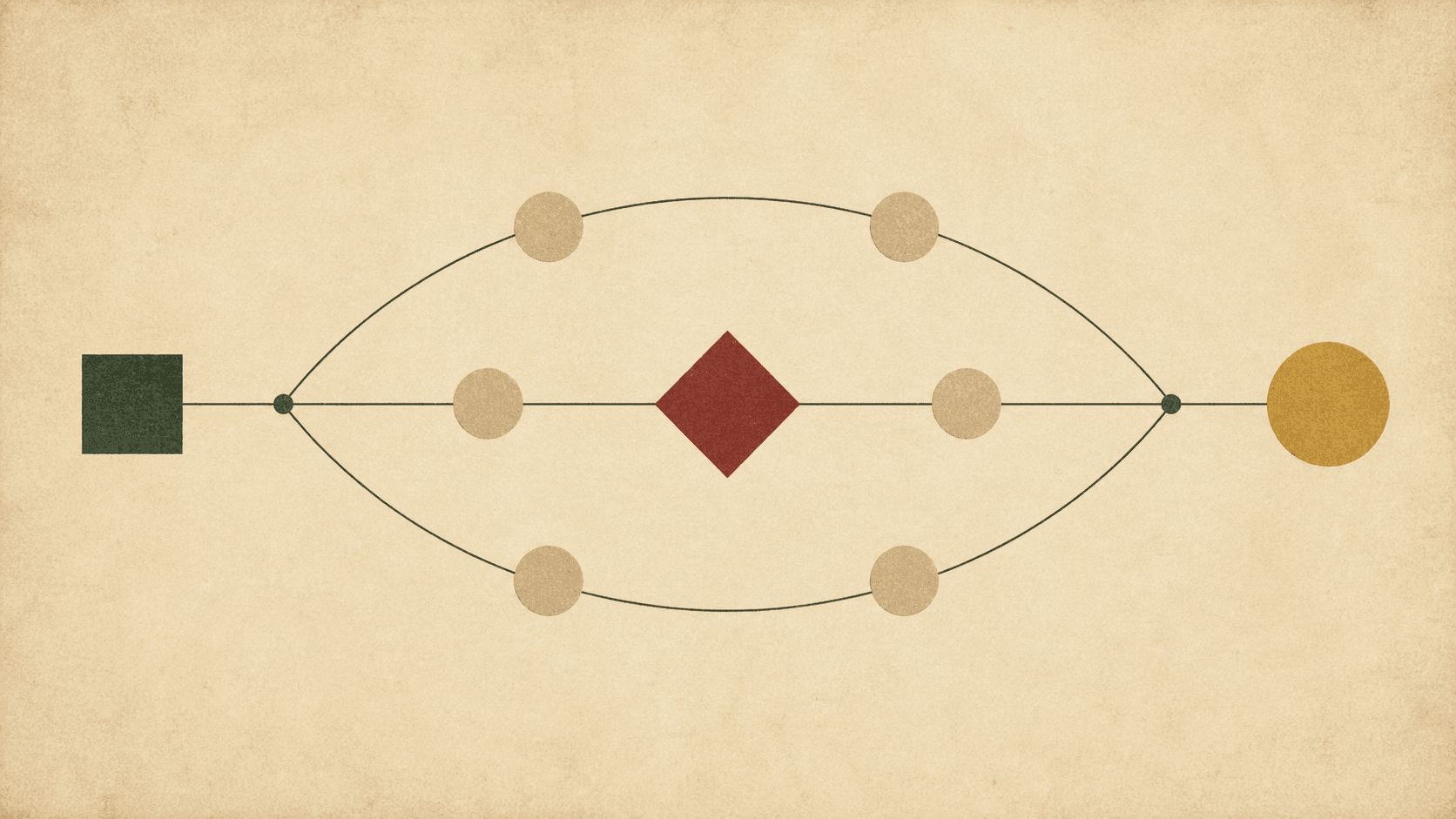 The hero leaves one state, moves through a wider network of trials and choices, then returns in a changed form.
Here is the practical version:
- Ordinary World - the protagonist before the adventure
- Call to Adventure - something disrupts the ordinary world
- Refusal of the Call - the protagonist resists
- Meeting the Mentor - guidance arrives
- Crossing the Threshold - the protagonist commits and enters a new world
- Tests, Allies, Enemies - the protagonist learns the rules of the new world
- Approach to the Inmost Cave - preparation for the central ordeal
- The Ordeal - the protagonist faces their greatest fear or challenge
- Reward - the protagonist gains something from surviving the ordeal
- The Road Back - the protagonist begins returning to the ordinary world
- Resurrection - a final test that proves the protagonist's transformation
- Return with the Elixir - the protagonist returns, changed
Open the interactive hero's journey template to place your stages and draw or test the arrows, or read the visual hero's journey guide if you want the twelve stages as a downloadable map. For a complementary cause-and-effect reading that tests whether each stage forces the next, see the cause-and-effect map guide.
What is the Save the Cat beat sheet?
The Save the Cat beat sheet is a fifteen-beat structure for a screenplay, and it exists to solve the Act Two problem by giving the middle page targets instead of one vague act. The beats run Opening Image, Theme Stated, Setup, Catalyst, Debate, Break into Two, B Story, Fun and Games, Midpoint, Bad Guys Close In, All Is Lost, Dark Night of the Soul, Break into Three, Finale, and Final Image, with the Catalyst around page 12, the Midpoint at 55, All Is Lost at 75, and a Final Image at 110 that mirrors the opening to show what changed. Three of those are the real hinges: catalyst, midpoint, and climax. It is most useful for commercial genre film and genre novels. The fair criticism is that rigid adherence produces predictable scripts, so treat the page numbers as scaffolding rather than a cage.
 Save the Cat's 15 beats on a timeline. Diamond markers show the catalyst, midpoint, and climax, the three structural hinges of the screenplay.
Blake Snyder's beat sheet solves the Act Two problem by breaking the entire screenplay into 15 specific beats with page counts:
- Opening Image (p. 1) - a snapshot of the protagonist's world before the story
- Theme Stated (p. 5) - someone states the theme, often to the protagonist
- Setup (pp. 1-10) - establish the protagonist's life and what needs to change
- Catalyst (p. 12) - the inciting incident
- Debate (pp. 12-25) - the protagonist hesitates
- Break into Two (p. 25) - the protagonist chooses to act
- B Story (p. 30) - a subplot (often romantic) that carries the theme
- Fun and Games (pp. 30-55) - the "promise of the premise" plays out
- Midpoint (p. 55) - false victory or false defeat; stakes are raised
- Bad Guys Close In (pp. 55-75) - external and internal pressures mount
- All Is Lost (p. 75) - the lowest point
- Dark Night of the Soul (pp. 75-85) - the protagonist wallows before finding clarity
- Break into Three (p. 85) - the protagonist discovers the solution
- Finale (pp. 85-110) - the protagonist executes the plan and prevails
- Final Image (p. 110) - a snapshot that mirrors the opening, showing change
If you are deciding between the two most common frameworks, Save the Cat vs three-act structure compares their beats, timing, flexibility, and best use cases directly. For page targets, a free PDF worksheet, and the interactive map, use the Save the Cat beat sheet guide or open the interactive Save the Cat template.
What is Dan Harmon's Story Circle?
Harmon distilled Campbell's monomyth into eight steps arranged in a circle. Designed for television, but it works for features and novels too.
- A character is in a zone of comfort (You)
- But they want something (Need)
- They enter an unfamiliar situation (Go)
- Adapt to it (Search)
- Get what they wanted (Find)
- Pay a heavy price for it (Take)
- Return to their familiar situation (Return)
- Having changed (Change)
The circle shape matters. The top half represents the known world, the bottom half the unknown. Steps 1 and 5 mirror each other, as do 3 and 7. The symmetry is the point.
The Story Circle works well for episodic writing because it scales down to a 22-minute episode. It also works for individual character arcs within a larger story. Writing an ensemble piece? Run a separate circle for each major character. For a complementary cause-and-effect / dead-link reading — not another eight-step checklist — see the Story Circle cause-and-effect map.
What is the seven-point story structure?
Novelist Dan Wells built this one for writers who know their ending, and his talk on it is worth the hour. Seven points:
- Hook - the starting state, the opposite of the resolution
- Plot turn 1 - the event that sets the story in motion
- Pinch point 1 - pressure is applied; the antagonist shows their strength
- Midpoint - the protagonist moves from reaction to action
- Pinch point 2 - the pressure becomes crushing; often the mentor falls or the plan collapses
- Plot turn 2 - the protagonist gains the final piece they need
- Resolution - the ending everything has been building toward
The trick is the order you plot in: start with the resolution, then write the hook as its inversion. A character who ends confident starts fearful. A world that ends free starts oppressed. Then place the midpoint as the hinge between the two states and fill in the turns and pinches around it.
This makes the seven-point structure the strongest template for writing backwards from an ending, which is most mystery and much of genre fiction. If you know where your story lands but not how it gets there, start here. For the full backward-planning order and a worked example, see the 7-point story structure guide.
What is the Fichtean Curve?
Rising action, almost nothing else. The Fichtean Curve, popularized by John Gardner in The Art of Fiction, skips the leisurely setup entirely. The story opens in the middle of action, then climbs through a chain of crises, each raising the stakes, until the climax lands around the 90 percent mark. A brief falling action closes it out.
The shape is a jagged upward line: crisis, partial recovery, bigger crisis, partial recovery, bigger crisis again. Exposition is not a phase; it gets smuggled into the gaps between crises while the reader is already invested.
This is the pacing engine behind most thrillers and page-turners. It also suits multi-POV novels, where each viewpoint can carry its own mini-crisis and chapters can end on alternating cliffhangers. The cost is breathing room: run every scene at crisis pitch and the reader goes numb. The partial recoveries are not optional; they are what makes the next spike register.
What is Kishotenketsu?
Kishotenketsu breaks a common assumption about what stories require. It is a four-part structure used across East Asian writing traditions that can organize change without using conflict as its central engine.
- Ki (Introduction) - establish the characters and setting
- Sho (Development) - deepen the established elements and pattern
- Ten (Turn) - introduce a contrast or another angle that changes the frame
- Ketsu (Connection) - connect the turn to the established elements
The structure builds through development and juxtaposition. A story may still contain an antagonist or confrontation, but those elements do not have to connect the four parts. Ten is more than a surprise twist. It supplies a contrast that Ketsu brings into relationship with Ki and Sho.
The complete Kishotenketsu guide explains Ki, Sho, Ten, and Ketsu with an original example and a visual outlining method. It is a useful option when a quiet or observational story feels distorted by a rising-conflict model.
How do you pick the right story structure template?
Pick a story structure template by sketching your idea against two or three of them and keeping the one it falls into naturally, rather than deciding in the abstract which framework is best. The choice usually follows the kind of change the story is about. A character transformation points at the hero's journey or the Story Circle. A commercial genre film points at Save the Cat, which gives the most concrete roadmap. A television episode or short story suits the Story Circle scaled down. A known ending with an unclear middle points at the seven-point structure, plotted in reverse. A tragedy or downfall arc points at Freytag's Pyramid, which puts the fall where it belongs. Thriller pacing points at the Fichtean Curve, and a quiet, contrast-led narrative points at Kishotenketsu. If you are unsure, start with three-act structure, the most flexible starting point, and switch only when the middle resists.
Some practical heuristics:
- Character transformation story? The Hero's Journey template or Story Circle.
- Commercial genre film? The Save the Cat beat sheet gives you the most concrete roadmap.
- Television episode or short story? Story Circle scales down well.
- Know the ending but not the middle? Seven-point structure, plotted in reverse.
- Tragedy or downfall arc? Freytag's Pyramid puts the fall where it belongs.
- Thriller pacing? The Fichtean Curve keeps the crises coming.
- Quiet, literary, or contrast-led narrative? Read the Kishotenketsu guide, or use three-act structure with a loose hand.
- Not sure yet? Start with the three-act structure template. Most flexible starting point.
Knowing multiple templates is not about following one to the letter. It gives you a vocabulary for diagnosing problems. Act Two sagging? The Save the Cat beats can pinpoint where energy drops. Character arc feeling hollow? Map it against the Story Circle to find the missing step.
Scyn's visual story structure templates let you map your story against any of these structures. Each beat is a node on a canvas: open the three-act template and the nine beats are already placed, with arrows showing which beat causes which. Replace the placeholder beats with your own scenes, and the gaps show up as missing nodes rather than a vague feeling that something is off. Color the nodes by act, and a sagging Act Two is a visible sparse stretch. The interactive three-act map linked earlier shows what this looks like with a finished structure.
If you are weighing Scyn against other tools while choosing a planning workflow, Scyn vs Plottr explains the difference between timeline-based outlining and cause-and-effect mapping, while Scyn vs Scrivener shows where a plotting tool fits relative to a full writing environment.
Templates are not creative limitations. They are lenses. The more you know, the more clearly you see your story.
Related reading
- Hero's Journey Template: A Visual Guide for Writers
- Cause-and-effect map guide
- Story Circle cause-and-effect map
- Save the Cat Beat Sheet for Screenwriters
- 27-Chapter Outline: 3 Acts, 9 Blocks, 27 Chapters
- Kishotenketsu: A Four-Part Story Structure Beyond Conflict
- Pixar Story Structure: Story Spine, Theme and Three Acts
- Save the Cat vs Three-Act Structure
- How to Use Story Structure Without Feeling Formulaic
- Visual Plot Mapping for Writers
- Browse all story structure templates