How to Structure and Map a Multi-POV Novel
Structure a multi-POV novel with parallel tracks, delayed consequences, bridge characters, and a who-knows-what check. Map cross-track cause and effect — then open the free visual template.
By Elias Ward
Founding writer at Scyn
A multi-POV novel works when every viewpoint has a distinct purpose, its own arc, and clear intersections with the others. This guide shows how to balance POV chapters, align parallel timelines, connect subplots, and build convergence points. Use the free visual template to map the structure as you work.
Delayed consequences, bridge characters, and a running check of who knows what when are what make those intersections feel earned. Without them, convergences arrive because the plot needs a meeting, not because the story has been forcing one.
Key takeaways
- Multi-POV novels are network structures. Linear outlines cannot show the cross-storyline connections that hold them together.
- Each POV character needs a full protagonist arc with their own wants, obstacles, and transformation. Otherwise they belong in a supporting role.
- Convergence points, where two or more storylines come together, are the structural payoff of the format. Mark them early.
- Disappearing characters, disconnected subplots, and forced convergences show up on a visual map. They hide in lists.
- Cross-track connections should get denser as the story approaches the climax: loose threading at the start, tight weaving at the end.
What is a multi-POV novel?
A multi-POV novel is a novel with multiple points of view. Each scene stays inside one character's perception. The structure holds several complete arcs on one timeline, passes information without mixing minds in the same scene, and brings the threads together as one story.
How many POV characters is too many?
A viewpoint earns its place with a complete arc. You have too many when two characters answer the same story question, or when one character lacks a want, an obstacle, and a change. Merge viewpoints that cover the same ground. Remove one if the plot, tension, and reader knowledge remain unchanged without it.
How do you switch POV without confusing the reader?
Stay in one mind for the whole scene. Head-hopping is the mid-scene jump into another character's thoughts. Carry the switch with a chapter break, a scene break, or a named heading. Signal whose eyes the reader is in within the first few lines: a name, a place only they occupy, a private concern. Switch after a question, a decision, or a threat, and return before that pressure goes cold. Do not recap the same hour from a second character unless the new viewpoint changes what the reader can know.
How do you balance POV chapters?
Keep each arc warm even when the chapter counts are uneven. Leave a character on an unresolved turn if you need a long stretch elsewhere. Do not park them in a quiet beat and then spend forty pages with someone else. A grid of viewpoint against act shows accidental absences. Consecutive chapters from one character signal importance; use that on purpose. As the story nears the climax, the threads should meet more often, not less.
A strict ABCD rotation gives readers a predictable rhythm but can feel mechanical. Group chapters by event when several characters must respond to the same turn. Cut between high and low tension when you want contrast. Break an established rotation when the change signals a shift in the story.
What is the problem with multi-POV outlines?
Open a standard outlining tool or a Word document and try to plan a novel with four POV characters. You immediately face a choice that has no good answer: whose story goes on the list first?
However you arrange it, you end up with one character's arc as the spine and the others as interruptions. You might write Arya's chapters from start to finish, then Tyrion's, then Jon's. That is not how the reader experiences the book. The reader lives in the intercut, moving from one character to the next, feeling the tension between storylines, watching the threads pull tighter until they snap together.
A linear outline cannot represent that intercut. It flattens a three-dimensional structure into one dimension. The result is that the structural problems of a multi-POV novel become invisible.
Why do linear outlines break down with multiple POVs?
Linear tools fail at multi-POV work for a specific reason: they cannot show simultaneity.
When Cersei is in King's Landing making a political move, and Daenerys is across the sea building an army, and Jon is at the Wall confronting a different kind of threat, those events happen at the same time in the story world. Their causal relationships run sideways across storylines as well as forward through time.
A list can only show one thing after another. It cannot answer the structural questions: how does Cersei's move change Daenerys's options? Which character creates the conditions for another character's scene? Where must the timelines align for a convergence to feel earned?
These are network questions. They require a network view.
There is also the problem of blank space. In a linear outline, it is easy to write "Chapters 1-8: Jon at the Wall" without noticing that you have just gone 120 pages without a single scene involving your other POV characters. The list does not signal that absence. A visual map does, instantly.
How does visual mapping handle parallel tracks and connected threads?
The core idea in visual multi-POV mapping is simple: each POV character gets their own horizontal track on a shared canvas. Their story events sit on that track in chronological order. Connections between storylines are drawn as explicit lines crossing from one track to another.
This gives you three things at once:
- The shape of each individual arc. You can see how each character's story rises and falls.
- The rhythm of the intercut. You can see how long you spend with each character before shifting to the next.
- The connections between storylines. You can see exactly which events in one character's arc affect events in another's.
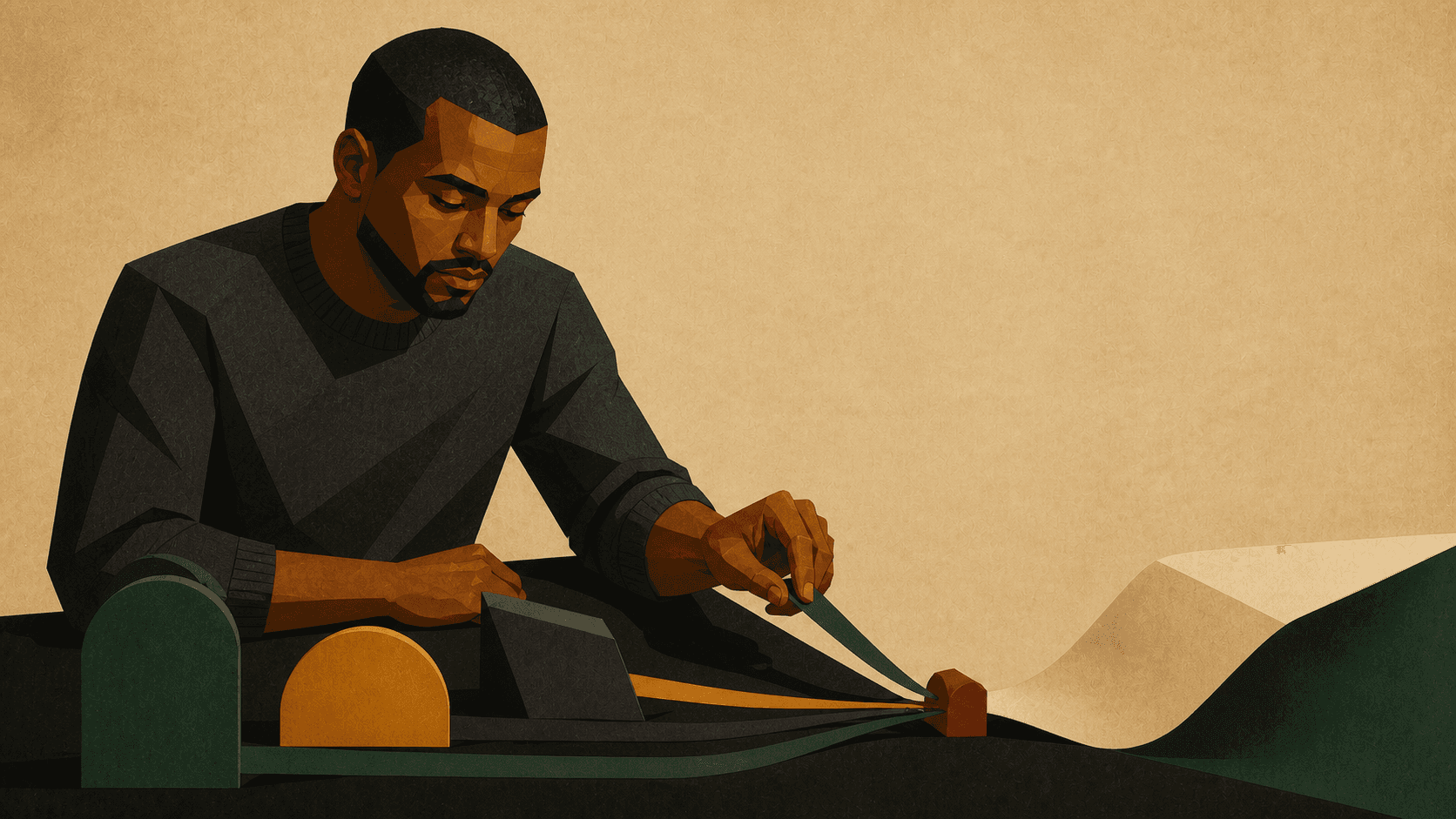 Three viewpoint threads develop separately, then change one another at a decisive shared event before moving toward the same resolution.
This visual structure does not require a particular tool. You can sketch it on paper, build it in a spreadsheet, or use index cards on a wall. The point is the parallel layout. As the story grows more complex, the ability to move events around, add new connections, and inspect the whole shape becomes more important.
Timeline vs causal network
A shared timeline answers when. A causal network answers what forces what. You need both layers.
Two scenes can share a calendar week and still have no effect on each other. Two scenes can sit months apart and still be the same causal chain: a choice on one track that only lands as a consequence on another. Place events on the timeline so story time stays honest. Then draw the edges that show force, not merely sequence. If you only have the calendar, you have a schedule. If you only have arrows, you lose the gap that makes a delayed consequence feel like a consequence rather than a coincidence.
Setting Up Character Tracks
Start by putting each POV character's name on a separate row. Give each character a color. Then place the events you already know for each character in rough chronological order along their track.
Do not worry about precision at this stage. You are creating a skeleton. A scene that happens "somewhere in Act Two" can sit at roughly the Act Two position. You can adjust as the structure becomes clearer.
Include only story events, not chapter numbers. You will figure out the chapter breaks later. What matters now is cause and effect.
Drawing Connections Between Storylines
Once your events are placed, start drawing connections between tracks. A connection should represent a real causal or informational link: Character A learns something that changes how Character B behaves. Character C's decision removes an obstacle from Character D's path. One character's failure creates another character's opportunity.
These cross-track connections are the ligaments of your multi-POV novel. Without them, you do not have a multi-POV story. You have several independent stories published in the same book.
Be ruthless about this. If you cannot draw a connection between two storylines, ask whether both need to be in this novel.
Delayed consequences across POV tracks
A delayed consequence is a cause on one track whose effect arrives later, often in another viewpoint. Audit each cross-track claim in four steps:
- Name the cause beat and whose scene it lives in.
- Name the effect beat and whose scene receives it.
- Measure the gap: chapters, story time, and what the reader knows in between.
- Run the epistemic check: can the receiving character act on this yet, or only the reader?
If two tracks snap together with no intermediate delayed edges, the convergence is forced. The missing work is not a better meeting scene. It is the chain of delayed consequences that should have been tightening toward it.
Bridge characters (information and tension carriers)
A bridge character carries information or tension from one track to another. They are not automatically a viewpoint. A messenger, a shared antagonist, a clerk who appears in two lives, a location that holds both characters' evidence: these are bridges. Give them a job on the map.
If two tracks never share a bridge of any kind — no person, no object, no place, no pressure that belongs to both — ask whether they belong in the same novel. A viewpoint is expensive. A bridge is often cheaper and more useful.
Identifying Convergence Points
A convergence point is where two or more storylines physically or causally come together. Characters might share a scene, or their actions from opposite ends of the story world might produce the same consequence.
Convergence points are structurally critical. They are where the payoff of the multi-POV structure lives. Readers invest in the separation between characters because they sense that the separation is temporary, that when these threads finally pull together, something significant will happen.
Mark your convergence points on the map. They often correspond to major act breaks and the climax. A map with no convergence points may reveal that the multi-POV structure lacks a shared purpose.
A worked twelve-chapter multi-POV example
Three viewpoints share one floodgate crisis. Mara needs proof the harbour records were altered. Ivo has to keep the harbour standing. Seline has the sabotage order. Their four chapters apiece work because the timeline contains two intersections, one information gap, and a climax they all cause.
Seline learns the plan in Chapter 6. Mara cannot act on it until she decodes the override in Chapter 10, while the reader spends four chapters knowing the danger. The map keeps that information gap honest by showing who knows what, and when.
Who-knows-what matrix (same floodgate beats)
The information gap is not only a wait. It is a set of facts that some minds hold and others do not. At the Chapter 6 to 10 stretch of the floodgate story, the same beats look like this:
| Fact | Mara | Ivo | Seline | Reader |
|---|---|---|---|---|
| Harbour logs were forged | Knows (Ch. 1) | Does not know until Ch. 7 | Knows a cover-up exists (Ch. 3) | Knows (Ch. 1) |
| High-tide sabotage plan | Does not know until Ch. 10 | Does not know | Knows (Ch. 6) | Knows (Ch. 6) |
| The gate has been rigged | Does not know | Knows (Ch. 8) | Knows the plan requires it (Ch. 6) | Knows (Ch. 8) |
| Manual override decoded | Knows (Ch. 10) | Does not know until Ch. 11 | Does not know until Ch. 11 | Knows (Ch. 10) |
Mara cannot act on the high-tide plan in Chapter 7 or 8 because she does not have it yet. If she did, the matrix would catch the leak before the draft did.
Common Multi-POV Structural Problems (and How to See Them)
These are the patterns that appear repeatedly in struggling multi-POV manuscripts. They are difficult to spot in a linear outline. They are hard to miss on a visual map.
The Disappearing Character
You have four POV characters. Three of them are doing interesting things. The fourth goes unmentioned for 150 pages.
In a list-based outline, this can hide easily. You might not notice until you tally up the chapters. On a visual map, the fourth character's track just stops. The gap is spatial. You see the white space where their presence should be.
The fix is not always to add more chapters for the missing character. Sometimes the right answer is to tighten the other three storylines so the gap closes. But you cannot make that decision until you can see the gap.
The Disconnected Subplot
A character has a rich internal storyline that never meaningfully intersects with anything else in the novel. Their arc is internally coherent, even compelling. But you cannot draw a single connection line from their track to anyone else's.
This often happens when a writer becomes attached to a character for personal reasons, or when a storyline was conceived separately from the main story and grafted on. The disconnection feels justifiable from inside the story. On the map, it reads as an island.
Either find the connection or cut the character. Readers will feel the disconnection even if they cannot name it.
The Lopsided Arc
One POV character has fifteen events on the map. Another has four. A third has seven. The distribution of story real estate across your characters is unequal in ways that distort the reader's experience.
Unequal distribution can be deliberate. One character might carry sixty percent of the narrative weight while the others provide context and counterpoint. Normal People focuses on Connell and Marianne, with no supporting POVs. The Hours gives comparable weight to its three women, though Laura Brown's sections carry a different emotional pressure.
Unplanned lopsidedness creates the structural problem. If you meant to give two characters equal weight but one has five times as many events on the map, revise the distribution or redefine their roles.
The Forced Convergence
Two storylines that have had no genuine connection for four hundred pages suddenly bring their characters together. The convergence happens because the plot requires it, not because the story logic has been building toward it.
On a visual map, a forced convergence looks like two parallel tracks with almost no cross-connections, and then a single point where they snap together. The absence of intermediate connections is the tell. A well-prepared convergence will have a series of increasingly dense connections in the chapters leading up to it, causal links being drawn tighter and tighter until the meeting feels inevitable rather than convenient.
What do multi-POV structures look like in practice?
Looking at how specific novels handle multi-POV structure is more useful than abstract principles. These three examples represent different structural solutions to the same challenge, and they look nothing alike on a map.
Rotating POV (A Song of Ice and Fire)
Martin's approach is the purest expression of the parallel-tracks model. Each chapter is attributed to a named character. The characters are geographically separated for most of the series. Their storylines connect causally and thematically, but the characters themselves rarely share a scene.
The structural commitment here is enormous. Martin trusts that the causal network, the fact that Cersei's decisions have consequences for Dany's situation, which has consequences for Jon's situation, which feeds back to Westeros, is sufficient to make the reader experience these as one story.
On a visual map, the A Song of Ice and Fire structure would show multiple horizontal tracks with few direct character-to-character connections and dense causal links across the tracks. The storylines converge off-page through the world each character's actions reshape.
Converging POV (Cloud Atlas)
David Mitchell's structure is architecturally unusual: six storylines nested inside each other like Russian dolls, with each one interrupted at its midpoint by the next. The reader descends through all six half-stories, hits the innermost story complete, then ascends back through the other five in reverse order.
The convergence here is not a meeting of characters. It is a convergence of themes and a literal reversal of structure. Each storyline connects to the next through artifacts and echoes: a manuscript read by the next character, a piece of music composed by the next, a film watched by the one after.
On a visual map, Cloud Atlas would look like a concentric arc structure rather than parallel tracks. The connections run forward in time through artifacts, not through direct causation. The map shape itself would be unusual, which is exactly the point: this novel is doing something structurally distinct from traditional multi-POV work.
Parallel POV (The Hours)
Michael Cunningham's three-storyline structure runs three women's days simultaneously across different eras: Virginia Woolf writing Mrs. Dalloway in the 1920s, a housewife reading Mrs. Dalloway in the 1950s, and a woman in the 1990s living a life that echoes Mrs. Dalloway.
The characters never meet. The connections are entirely thematic and symbolic. What holds the novel together is resonance rather than causation: similar emotional textures, recurring images, parallel choices.
This is the hardest type of multi-POV structure to map causally, because the causal links are largely absent. What you would map instead are thematic connections, moments in one storyline that rhyme with moments in another. The map becomes a tool for tracking resonance rather than plot mechanics.
How do you build your multi-POV map?
This is the practical process for building a working map from scratch, or for mapping a draft that already exists.
Start with Each Character's Arc Independently
Before you think about how the storylines connect, write out each character's story on its own. What does this character want? What is in the way? What is the moment where everything changes for them? What do they become by the end?
Give each character a proper three-act arc, or whatever structural template fits. Do not shortcut this step. A multi-POV novel fails when its secondary POV characters lack protagonist roles. They need to want things, make consequential choices, and change.
Map each arc as a standalone sequence of events. Do not think about the other characters yet. This forces you to test whether each POV character has enough story to carry chapters, or whether some of them are supporting characters wearing a protagonist's hat.
Layer the Arcs onto a Shared Timeline
Now place all the arcs on the same canvas with a shared time axis. Each character gets a horizontal track. The left-to-right axis represents story time. Open the free visual multi-POV template. Place each viewpoint on its own track, draw the connections yourself, and mark delayed consequences and information gaps.
Pay attention to where events cluster. Three major scenes from three different characters all happening at roughly the same point in the timeline might be the structural convergence you did not know you had. Or it might be a pacing problem: too much happening at once, with nothing in the earlier or later sections.
This is also where you will discover timeline contradictions. Character A's major decision in Act Two depends on information that, according to Character B's timeline, has not happened yet. Visual mapping makes these inconsistencies impossible to ignore.
Draw the Connections
With the arcs laid out in parallel, start drawing the cross-track connections. Use a distinct color or line style for different types of connection: causal links, informational links, thematic echoes.
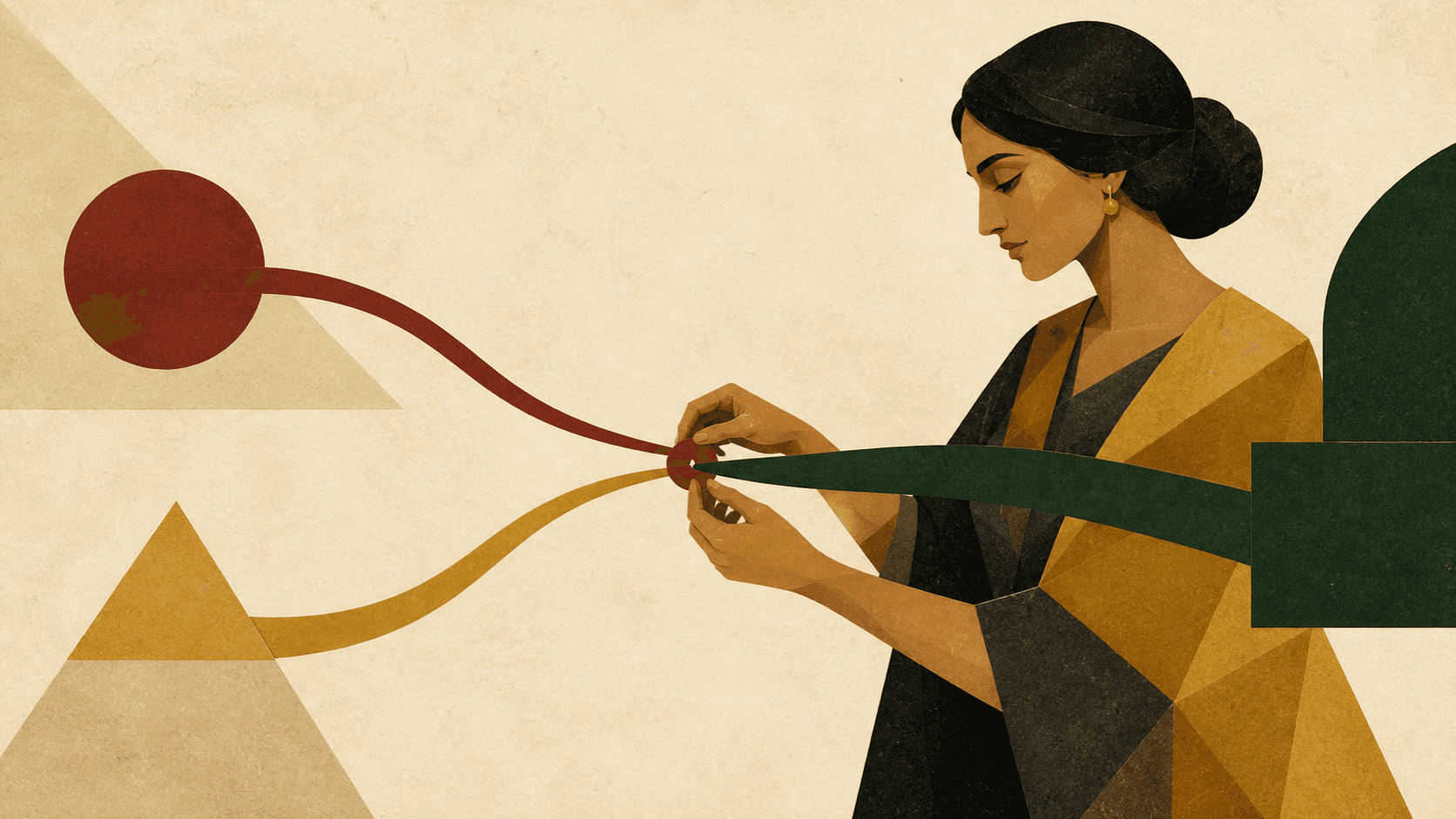 Several storyline streams merge at one convergence point. This is where the payoff of the multi-POV structure lives.
A multi-POV story mapping tool is built for this stage. Place each character's events as nodes on a canvas, assign them to tracks, and draw the connection edges yourself. Mark delayed consequences and information gaps as you go. The result shows where the threads run apart and where they converge. A general-purpose diagramming tool makes this harder because it does not understand story events or the difference between a causal connection and a thematic echo.
On paper or any other surface, the process is the same. What matters is making the connections explicit rather than holding them in your head.
You can also read the visual plot mapping fundamentals and story structure templates articles for more on the underlying structural thinking that informs how to use these maps.
Multi-POV diagnostic checklist
- Each viewpoint character has a want, an obstacle, and a change of their own.
- No viewpoint covers the same question as another.
- Every thread changes at least one other thread.
- Story time lines up across tracks. No character acts on facts that have not happened yet.
- POV changes at a scene or chapter break, never mid-scene.
- No character vanishes for a long stretch unless you can name the reason.
- Convergence points appear throughout the story, including major turns before the last chapter.
- Cross-story connections get denser as the climax approaches.
- Delayed-consequence edges are named, not only a shared calendar.
- Bridge characters or shared pressures are visible on the map.
- A who-knows-what check holds: no character acts on a fact they cannot know.
When are multiple POVs not the answer?
Multi-POV is not a neutral structural choice. It has real costs.
Each POV shift asks the reader to release one character's emotional thread and pick up another's. That is cognitive and emotional work. Readers will accept it when the new viewpoint expands the story and resist it when the shift feels like an interruption.
Multi-POV multiplies the writing workload. You are writing several protagonists' interiority, dialogue, and perception, and each needs a distinct voice. Characters who share the same emotional register and blind spots give the reader no reason to follow each viewpoint.
Ask yourself three questions before committing to multiple POVs:
Is there something essential to the story that only a different POV can show? If you can show everything you need through a single character, you probably should.
Are your secondary POV characters full protagonists with their own wants, arcs, and transformations? If they feel more like witnesses than agents, they may belong in a secondary role rather than a POV role.
Does the multi-POV structure create something that would not exist with a single POV? In The Hours, the parallel lives argue a theme that no single character could carry. In Game of Thrones, the geographic separation makes the scope of the world real in a way a single POV never could. If your multi-POV structure does not add something qualitatively different, the simpler approach is usually better.
A strong multi-POV structure lets readers see a situation from several sides and feel the irony between lives that cannot see each other. You control that structure by making its tracks and connections visible, including the points where they converge.
Related reading
- Visual Plot Mapping for Writers
- Story Structure Templates Every Writer Should Know
- Hero's Journey Template: A Visual Guide for Writers
- Hero's Journey Diagram: Map Cause and Effect Between Stages — the same cause-to-effect discipline on a single-hero framework, not a multi-POV substitute