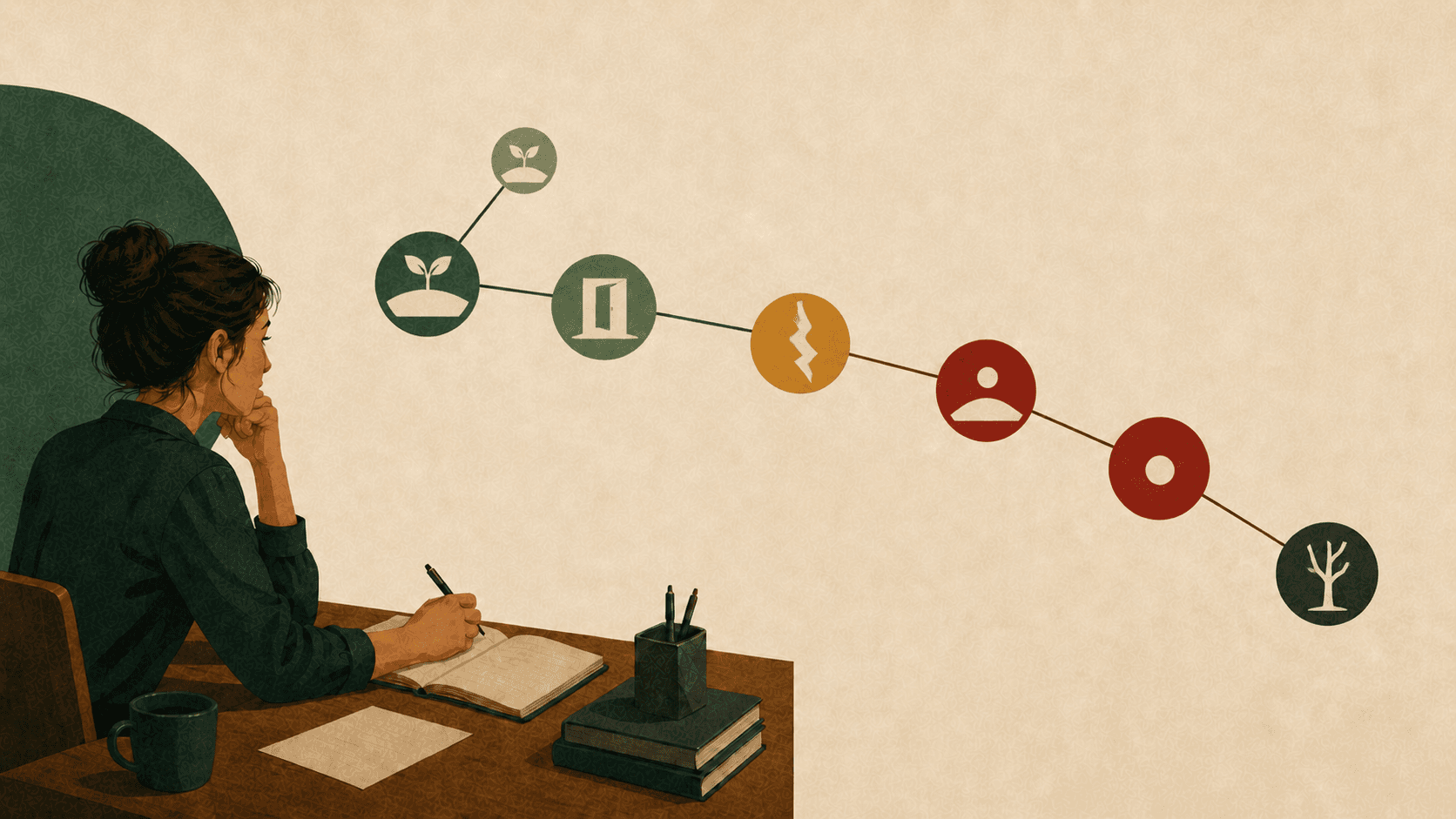
Character Development: Build a Character Arc With Examples + Worksheet
Build a character development arc from belief, want, and need. Includes positive, flat, and negative examples plus a copyable worksheet from opening state to final choice.
By Elias Ward
Founding writer at Scyn
Key takeaways
- Character development makes a person specific. A character arc is the change that person makes under pressure.
- An arc needs a starting belief, a want, a need, pressure, a choice, a consequence, and a final state the reader can see.
- Positive, flat, and negative arcs all use that model. They differ in who moves and whether the ending is closer to the truth or farther from it.
- Familiar stories help you recognize the pattern. The worksheet is how you apply it to your own book.
- In Scyn, internal turns earn their place only when they cause an external plot event.
Writers often use "character development" and "character arc" as if they were the same task. They are related, and they are not the same job. Development gives you a person worth watching. An arc gives that person a direction.
What is a character development arc?
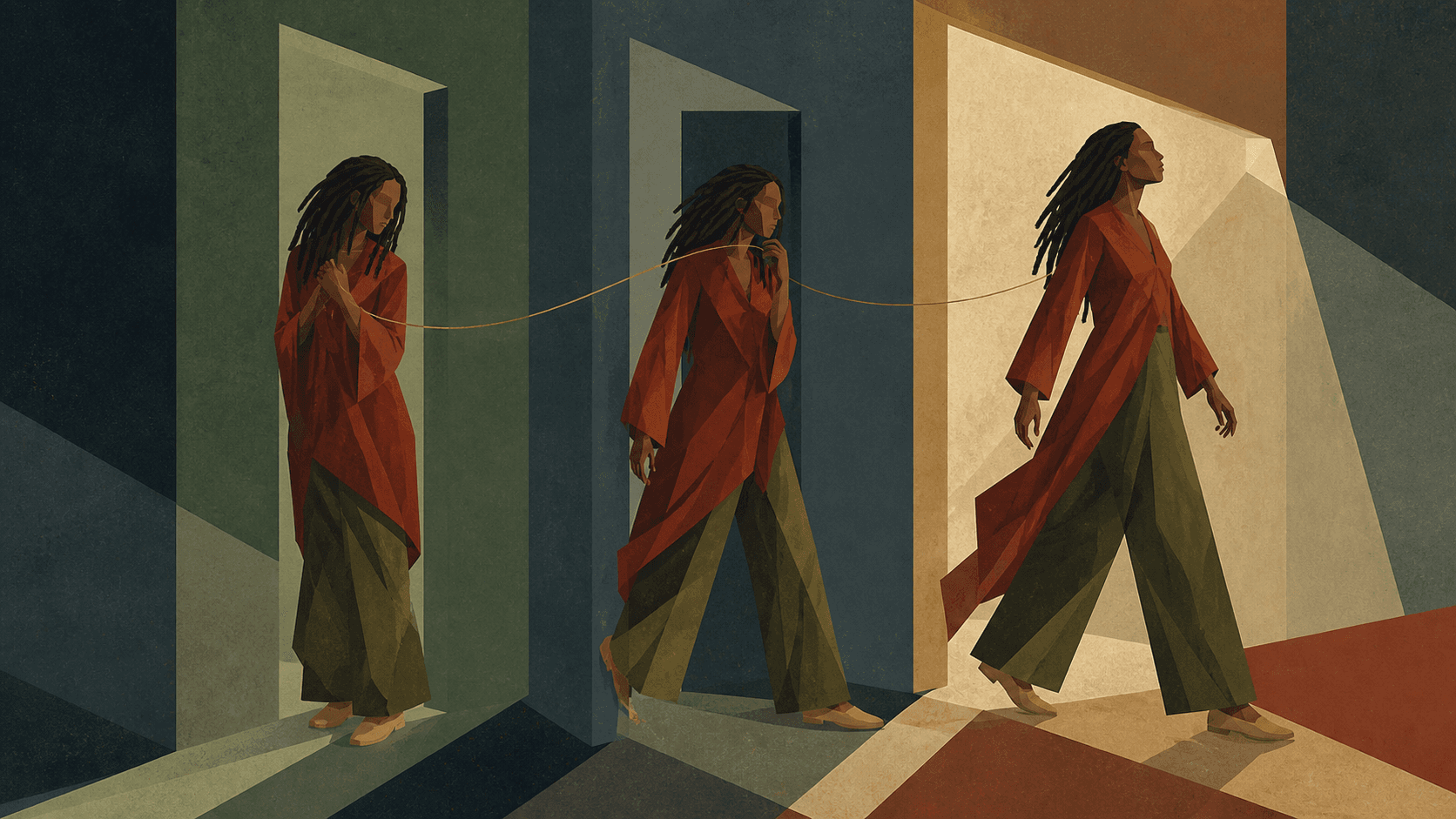
A character development arc is the path from an opening inner state to a different final state, proved by choices the plot forces into the open. The reader should be able to point to an early behavior, a later decision, and an ending image, then say what changed.
The usual engine is a gap. The character wants one thing and needs another. The want is conscious and urgent. The need is the change that would actually solve the deeper problem. Pressure makes the gap expensive to ignore.
One widely used version of this split comes from K.M. Weiland's character-arc work: a positive change arc moves toward a fuller truth, a flat arc holds that truth while the world moves, and a negative arc moves away from it. The labels are craft terms, not product categories. Use whichever label helps you plan the ending.
Character development is not the same as an arc
Character development is the work of making someone particular. Occupation, history, habits, contradictions, the way they enter a room, the thing they will not say to the person they love. A well-developed character can stay internally still. Many mentors, antagonists, and short-story protagonists do exactly that.
An arc is narrower. It is a movement the plot can test:
- The character begins with a belief that governs behavior.
- The story applies pressure that makes that belief costly.
- The character chooses, more than once.
- The ending shows a new pattern, a hardened old pattern, or a collapse.
You can spend weeks developing a backstory and still have no arc if the plot never forces a decision that the opening version of the character would have made differently. You can also write a loud "transformation" that is only a costume change: new job, new city, same governing belief.
If the external plot is still unsettled, start with the novel outlining process and add the arc once the ending is more than a mood.
Positive, flat, and negative arcs
Positive arc
The character begins with a limiting belief that once protected them. The story rewards that belief early, then makes it fail in public. By the end they act on a harder truth.
Ebenezer Scrooge begins certain that generosity is waste. The visitations do not lecture him into kindness. They make his rule unlivable, and the ending shows a different daily practice: he spends, he joins, he repairs.
Elizabeth Bennet begins confident in her own reading of people. The plot does not ask her to become meek. It asks her to revise a judgment she enjoyed, then act on the revision. The letter, the visit to Pemberley, and the later defense of Darcy are visible evidence, not a private change of heart.
Flat arc
The protagonist already holds the story's central truth. The pressure tests whether they will keep acting on it while other people, institutions, or the reader argue for a more convenient lie.
Steve Rogers does not spend Captain America: The First Avenger discovering that bullies should be opposed. He already believes that. The story asks what that belief costs in a world built for the opposite rule. Paddington works in a similar way: his faith in kindness changes the Brown family and the people around them more than it changes him.
A flat arc still needs choice. If nobody can tempt, isolate, or punish the character, the truth is untested and the plot is only a tour of their virtues.
Negative arc
A negative arc uses the same pieces and aims them at loss. The character refuses the truth, misunderstands it, or uses what they learn to do more harm. In Shakespeare's Macbeth, each violent attempt to secure power makes further violence feel necessary. His circumstances change while the destructive belief hardens.
The dedicated negative character arc guide covers disillusionment, fall, and corruption, and it shows how early rewards make the destructive belief believable. Use this article to decide whether your story is that shape. Use that one to build the descent.
A working model: belief to final state
Track seven pieces. If one is missing, the arc will feel asserted rather than earned.
| Piece | Question | What it gives the plot |
|---|---|---|
| Belief | What rule does the character live by when the story opens? | The behavior the later choices must test. |
| Want | What external thing do they pursue? | Direction, urgency, and a visible goal. |
| Need | What change would actually help them? | The thematic argument of the book. |
| Pressure | What event makes the belief expensive? | The reason they cannot stay private. |
| Choice | What do they do when both options cost something? | Agency. Without this, you have misfortune. |
| Consequence | What becomes true because of that choice? | Causality the next scene can inherit. |
| Final state | What can a stranger observe at the end? | Proof. A spoken lesson is not enough. |
The belief should have a history. "She is proud" is a label. "She learned that asking for help got her family evicted, so she treats every offer as a trap" is a rule the plot can break.
The want should be concrete enough to fail. A promotion, a sale, a verdict, a rescued person, a kept secret. The need should collide with the method they use to chase that want. If they can get the want without touching the need, the inner story is optional and readers will feel it.
A complete original example
Len Voss is a municipal records clerk. He believes, "If I keep the files complete, I do not have to take a side." He wants the head-of-records post after his supervisor retires. He needs to admit that filing is already a side: what he preserves, delays, or "loses" decides who can prove what.
A developer asks for a "routine" deletion before a waterfront vote. Len's sister lives in the affected block. The first pressure is small and professional. He can comply and look like a careful employee.
He copies the survey instead of destroying it, then tells himself he is only protecting process. That is the midpoint. He has moved from filing what he is told to acting, but he has not yet given up the belief that neutrality will save him.
At the hearing he can stay silent and keep the promotion, or read the missing survey aloud. He reads it. He loses the post. The archive changes its deletion rule. The final image is ordinary on purpose: during public hours, Len leaves the cabinet unlocked. The want is gone. The need is visible.
That is a positive arc. The same seven pieces would build a flat version if Len already believed the records belonged to the public and the city spent the book trying to make him a quieter employee. They would build a negative version if he used the copied survey to threaten his rivals and ended as the person who decides which files exist.
The arc is visible when an opening belief, a later choice, and a final behavior sit on the same causal line.
Character arc worksheet
Copy these prompts into a document or onto a canvas. Answer in sentences. If you can only fill a field with an adjective, the arc is not ready.
Opening state
- Name and public role:
- Private fear the reader should infer, not be told:
- Opening belief (the rule they live by):
- First scene that makes that belief visible:
- Who already pays for this belief before page one?
Want and need
- External want, stated as an obtainable thing:
- Why they want it now:
- What they are willing to trade for it:
- Internal need:
- How the want and the need pull in different directions:
- What "success" would look like if they got the want and refused the need:
Pressure
- First event that tests the belief:
- Who or what applies that pressure:
- Short-term reward for staying the same:
- First cost they can still excuse:
- Later pressure that makes the excuse look thin:
Choices
- Early choice that still protects the old rule:
- Midpoint decision (more active, more honest, or more rigid):
- What new plan follows that decision?
- Lowest choice, when both options cost something real:
- Who sees that choice, and what do they now know?
Final choice and ending evidence
- The last decision:
- Who is helped or harmed by it:
- Changed behavior a stranger could observe:
- Final image that proves the new state:
- Opening image this ending should answer:
- What would still be true if they had not changed?
If the last two answers are the same, you have development without an arc, or an ending that restates the beginning.
Connect internal turns to plot events
Plot the external events in one row and the character decisions beneath them. Draw a directional link only when an inner turn changes what someone does: they hide a file, refuse a ride, call a sister, leak a name, stay silent in a room where silence is a vote.
Use color as a highlighter, not as a taxonomy. One color for the public plot, another for the belief being tested, works well. Filter by act when you want to see whether Act Two still contains choices or only weather. Scyn does not need named arc types or typed link categories for this. Nodes, arrows, act filters, and a small color set are enough.
Start with the character arc template. It already has places for starting belief, want, need, pressure, lowest choice, and changed behavior. Link that map to the three-act structure template so a midpoint realization is also a plot event. Browse the complete free template library if you need a scene layer or a second viewpoint beside the arc.
Common mistakes
A backstory dump is not pressure. The reader needs a present-tense cost.
A stated moral is not a final state. If the character gives a speech and then behaves as they did in chapter two, the arc is still a caption.
Sudden virtue is not development. Seed the later choice with an earlier, smaller version of the same risk.
Protecting the protagonist from consequences will flatten a positive arc as surely as it flattens a negative one. Acting on the new belief has to carry a real cost.