How to Write a Negative Character Arc
Build a negative character arc through belief, choice, and consequence, with three arc types, a three-act map, examples, and common mistakes.
By Elias Ward
Founding writer at Scyn
Key takeaways
- A negative arc tracks choices that leave a character with less truth, freedom, or human connection.
- The character needs agency. Misfortune alone does not create an arc.
- Disillusionment, fall, and corruption arcs end badly for different reasons.
- Early rewards make the destructive belief credible; later costs reveal its full price.
- Map every major choice to the warning ignored, threshold crossed, and consequence created.
A negative character arc is often summarized as "a character gets worse." That description misses the mechanism. A convincing arc shows why the character keeps choosing a harmful belief even as the evidence against it grows.
The ending feels earned because the character had chances to change. They misunderstood those chances, refused them, or used what they learned to move further in the wrong direction.
What is a negative character arc?
In a positive arc, the protagonist replaces a limiting belief with a fuller truth. A flat-arc protagonist already holds the story's central truth and changes the people around them. A negative arc moves toward loss, distortion, or moral collapse.
K.M. Weiland's character-arc framework describes three negative change arcs. Writers name and divide them differently, but this three-part model is useful:
| Arc type | Starting position | Ending movement |
|---|---|---|
| Disillusionment | The character believes a comforting lie. | They discover a harsh truth but cannot turn it into a healthier life. |
| Fall | The character clings to a lie despite repeated chances to reject it. | Their final choice destroys what remained. |
| Corruption | The character begins near the truth or with a workable moral boundary. | They knowingly choose the lie because it offers power, safety, love, or status. |
These types can overlap. The distinction helps you identify where the pressure belongs. A disillusionment arc breaks an illusion. A fall arc tests refusal. A corruption arc makes temptation credible.
The downward movement comes from decisions, not a general increase in suffering.
Start with a belief that works
The harmful belief needs a reason to survive. It may have protected the character in the past or still produce short-term rewards.
Suppose a political organizer believes, "People only act when they are afraid." Fear helped her community survive an earlier attack. In Act One, alarming messages increase attendance and donations. The lie works well enough that caution looks weak.
If the belief is foolish from the first page and never rewards the character, readers will wait impatiently for them to abandon it. Give the lie a history, a benefit, and a cost the character can initially excuse.
Then identify the truth the story will test. In this example: durable solidarity requires trust and shared agency. The truth should challenge the method the character uses, not merely offer generic advice to be kinder.
Build the arc from choices
Track six pieces of information:
- The lie the character believes.
- The external thing they want.
- The deeper need the lie prevents them from meeting.
- The warnings or counterexamples they encounter.
- The choices that deepen or challenge the lie.
- The final state created by the decisive choice.
The protagonist does not need to understand every warning. Readers should. An ally may model a healthier response. An antagonist may speak an uncomfortable truth for selfish reasons. Weiland notes that in a negative arc, an opposing character can function as the voice of the story's healthier proposition.
That reversal can make the story more interesting. The antagonist does not become good, and the protagonist does not become wrong about everything. It means moral insight and moral behavior do not always arrive in the same person.
A negative character arc across three acts
Act One: make the lie useful
Show the character applying the belief in ordinary life. Give it a visible reward. Then introduce a goal that makes the same method more dangerous.
The first act break should contain a choice. The organizer leaks an exaggerated threat to fill a public meeting. Attendance doubles, and officials finally respond. She crosses a line, but the result confirms her worldview.
Act Two: raise the reward and the cost
Act Two should not repeat the same bad choice. Each decision needs a larger reach or a more intimate cost.
At first, the organizer frightens strangers. Then she withholds information from her team because she expects hesitation. At the midpoint, her campaign wins a major concession. The apparent victory gives her control and proves, in her mind, that fear works.
After the midpoint, the concealed costs surface. A false rumor targets an innocent person. An ally discovers the manipulation. The organizer can confess, share power, and risk losing the campaign. Instead, she creates another threat to keep the group united.
The low point should offer a real chance to change. A story becomes fatalistic if the protagonist never sees another path. Give them enough truth to choose differently, then make the refusal specific.
Act Three: make the final choice irreversible
The climax tests the belief under maximum pressure. The organizer can expose her own deception and lose the election, or release a fabricated recording that will secure victory. She releases it.
She wins office but destroys the community's trust. The final image might mirror the crowded meeting from Act One: the same hall is now empty while she addresses supporters through locked screens. The external want has been achieved. The internal need is further away than ever.
The ending does not need death or punishment. It needs a final state that follows from the character's choices and makes the thematic cost visible.
How the three negative arcs feel different
Disillusionment
The character reaches the truth, but the truth removes a sustaining belief and leaves no workable replacement. This arc suits stories about innocence, institutions, or relationships whose real nature cannot be unseen.
The danger is confusing maturity with despair. The ending needs a concrete loss or narrowing of possibility, not only a darker opinion.
Fall
The character receives several chances to accept the truth and refuses each one. Shakespeare's Macbeth becomes harder and more isolated as he answers the consequences of violence with further violence.
The choices should still vary. Repetition flattens the arc. A lie told to gain power, a betrayal used to keep it, and an act of violence used to silence the truth can all grow from the same belief while crossing different thresholds.
Corruption
The character understands enough of the truth to choose against it. Temptation works because the lie offers something concrete. The offer may be safety, recognition, revenge, or relief from responsibility.
A corruption arc needs a credible moral starting point. If the character already accepts the final evil in Act One, the story is a fall or a static portrait rather than a movement into corruption.
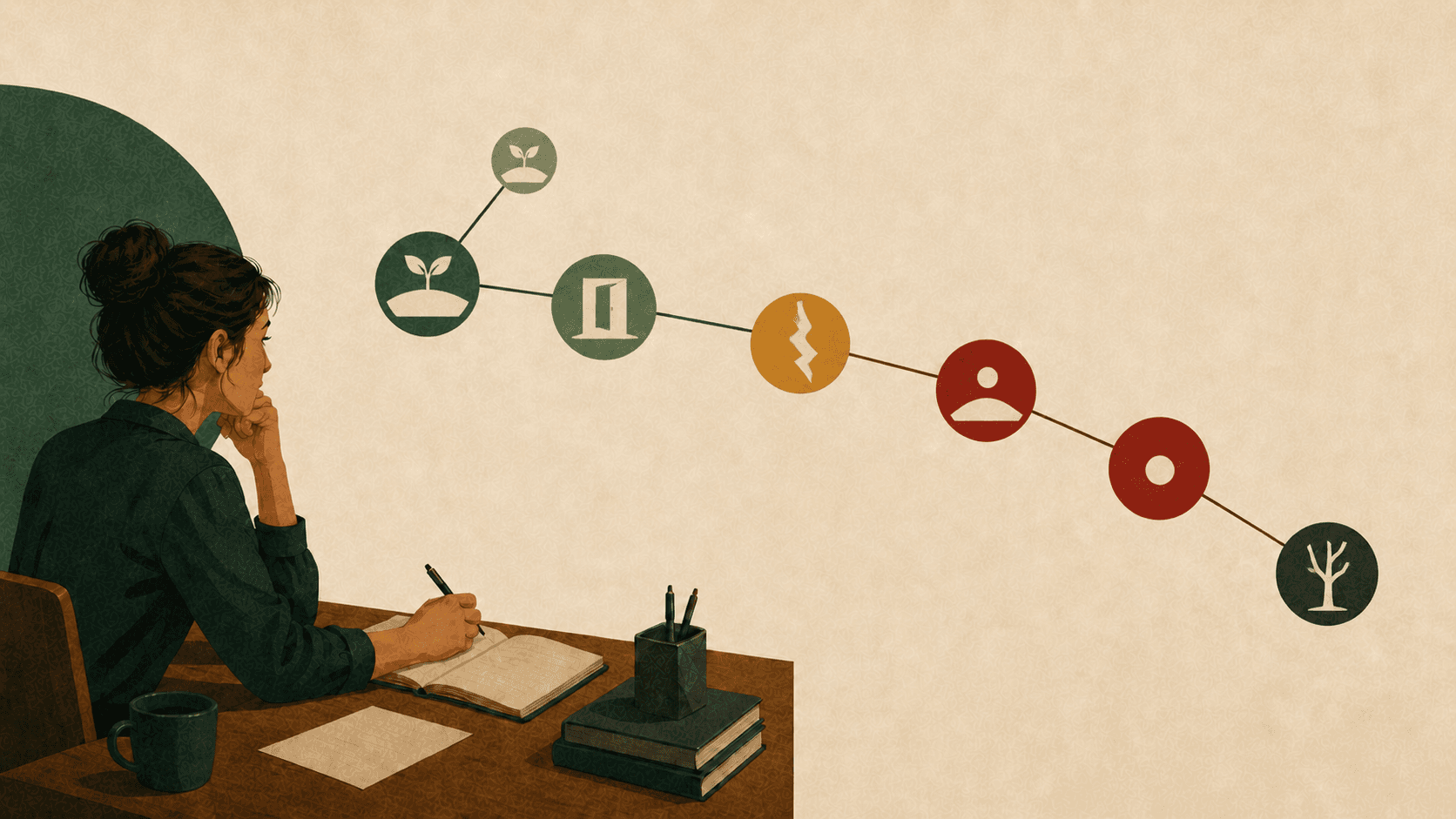
Map the arc visually
Plot the external events in one row and the character decisions beneath them. Link each decision to three things:
- the belief that made it seem reasonable
- the immediate reward
- the delayed cost
Mark thresholds that cannot be cleanly reversed. A first lie may be repairable. Destroying evidence changes the risks. Betraying the one person who knows the truth changes the relationships. The map should show a narrowing path created by the character, not a tunnel imposed by the author.
Scyn's character arc template gives you a starting canvas for belief, want, need, and turning points. Link it to the three-act structure template so the internal decisions cause external plot changes. A negative arc works best when the character's inner failure alters the whole story. Browse the complete free template library if you also need a starting map for subplots, scenes, or a multi-POV structure.
Common mistakes
Sudden cruelty is not development. Seed the belief and show the smaller choices that make the final one possible.
Constant punishment also weakens the arc. The protagonist needs rewards, allies, and moments of control or there is little reason to continue down the path.
Avoid removing agency at the climax. Possession, misunderstanding, or pure coercion can produce tragedy, but they do not prove the character's arc unless an earlier choice created that condition.
Finally, bleakness is not a theme. The ending should make a precise argument about the belief the character chose. Readers can leave disturbed, sympathetic, or angry, but they should understand how this person arrived there.