Pixar Story Structure: Story Spine, Theme and Three Acts
Use Pixar story structure to build a causal story spine, connect character want to need, and expand seven simple prompts into a visual outline.
By Elias Ward
Founding writer at Scyn
Key takeaways
- Pixar teaches a story spine popularized by improv teacher Kenn Adams; Pixar did not invent it.
- The repeated "because of that" prompts force events to have consequences.
- The spine is a compression tool. It helps you find the story before you build scenes.
- A strong version tracks an external want, an internal need, and the choice that connects them.
- You can expand the seven prompts into three acts, sequences, and individual scene cards.
Writers often search for a Pixar formula as if the studio uses one secret beat sheet. The most useful public version is much smaller: a story spine taught in Pixar's free Pixar in a Box storytelling course.
The spine can fit on a few lines. Its value comes from the links between those lines. One event disrupts a pattern. Each response causes another consequence. The ending changes the pattern established at the start.
What is the Pixar story spine?
Pixar credits the story spine to Kenn Adams, an improv teacher who popularized the exercise. The course uses these prompts:
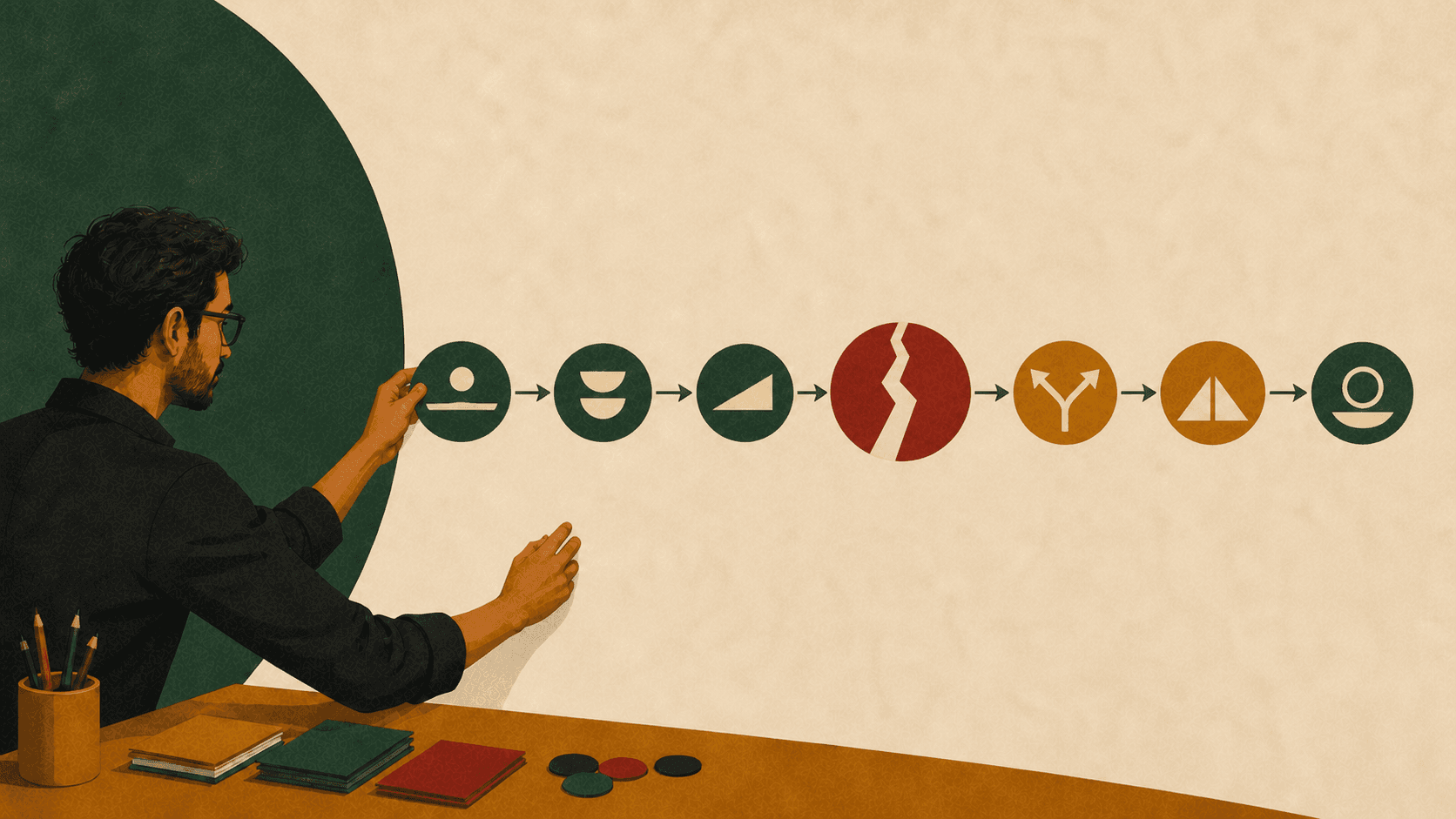
Once upon a time... Every day... Until one day... Because of that... Because of that... Until finally... Ever since that day...
The course also asks for the story's moral. That last prompt is best treated as a test of meaning rather than a sentence a character must say.
| Prompt | Structural job |
|---|---|
| Once upon a time | Introduce the protagonist and the world. |
| Every day | Establish the pattern that defines ordinary life. |
| Until one day | Break the pattern with a specific event. |
| Because of that | Show the protagonist responding and causing a new situation. |
| Because of that | Continue the causal chain as costs and understanding change. |
| Until finally | Force the decisive action that settles the main problem. |
| Ever since that day | Show the new pattern created by the ending. |
The story spine works when each beat changes the conditions for the next.
The words that make the spine work
"Because of that" prevents an outline from becoming a list of incidents. Compare these two sequences:
Lio misses the ferry. A storm begins. He finds a radio. The radio belongs to a smuggler.
The events share a character, but the relationships are weak. The writer could rearrange them without changing much.
Now connect the choices:
Lio misses the ferry because he stops to return a stranger's bag. Because of that, he is trapped on the island when the storm begins. Because of that, he breaks into the closed signal station and uses its radio. The transmission alerts the smuggler who owns it.
Each beat inherits a problem from the previous one. The protagonist also has agency. Lio's decision to return the bag begins the chain, and his later decisions keep changing it.
Use "therefore" as a check between cards. Use "but" when a consequence creates resistance or contradiction. If most links can only be described with "and then," the spine needs stronger causality.
A complete original example
Here is the story spine for an original animated adventure called The Last Mapmaker:
- Once upon a time, Nera drew safe sea routes for a town protected by a ring of mechanical lighthouses.
- Every day, she copied her missing mother's maps and refused to chart water nobody had crossed.
- Until one day, the outermost lighthouse walked away from the coast during a storm.
- Because of that, Nera sailed after it to restore the route before the fishing fleet returned.
- Because of that, she discovered the lighthouses were following an older map toward an island her mother had erased from every chart.
- Because of that, Nera abandoned the safe route, entered the uncharted water, and found her mother maintaining the failing island network alone.
- Until finally, Nera drew a new route connecting the town and island, then persuaded both communities to share responsibility for the lights.
- Ever since that day, the town's maps left room for routes that had not been drawn yet.
The external want is clear: bring the lighthouse back. The internal need is harder: Nera must stop treating inherited knowledge as a boundary. The finale resolves the practical danger through the change in her worldview.
The moral might be "A map should record discovery, not prevent it." You would not need to place that line in the script. The opening routine, final choice, and closing image already carry it.
How the story spine expands into three acts
The prompts fit naturally inside a broad three-act shape without replacing it.
Act One: establish and disrupt
"Once upon a time" and "every day" define the protagonist and ordinary pattern. "Until one day" supplies the inciting disruption. Act One then needs a choice that carries the protagonist into unfamiliar conditions.
For Nera, the moving lighthouse creates the disruption. Her choice to sail after it is the act break. If she were forced onto the boat without making a meaningful decision, later consequences would feel less personal.
Act Two: build a chain of consequences
You can repeat "because of that" as many times as the story needs. Each repetition should change at least one of these:
- the protagonist's plan
- the cost of failure
- the information available
- the relationship between want and need
The midpoint often supplies the largest change. Nera learns that her mother's maps were deliberately incomplete. The mission is no longer only a rescue. It becomes a confrontation with the belief that has governed her life.
Act Two weakens when consequences increase only in size. A larger storm after a smaller storm is escalation, but it may not develop the character or goal. Make the causal chain change direction as well as pressure.
Act Three: decide and prove change
"Until finally" should require a choice that the opening version of the protagonist could not make. Nera draws an untested route and shares ownership of the lighthouse network. Both actions contradict her original dependence on fixed maps and solitary authority.
"Ever since that day" then proves the ending lasted. A changed daily pattern often makes a stronger final image than a speech about growth.
Want, need, and theme
The spine can produce a mechanically tidy plot with an empty character arc. Add three questions beside it:
- What does the protagonist consciously want after the disruption?
- What belief prevents them from meeting the deeper need?
- Which final action proves that belief has changed, hardened, or failed?
Pixar's course treats theme as something the storyteller develops through the character's experience, not a slogan attached after the plot is finished. Want gives the story direction. Need gives choices their emotional meaning. The ending joins them, or exposes why they cannot be joined.
A protagonist can fail the internal test. The structure still works for tragedy or a negative arc if the final pattern shows the cost of that failure.
Turn the spine into a visual outline
Write each prompt as one node. Connect the first "because of that" chain with directional arrows. Then add links that do different structural work even if Scyn leaves the labels optional:
- connect the opening routine to the final routine
- connect the character's false belief to the choices it distorts
- connect an Act One detail to its later payoff
- connect the midpoint discovery to the final plan it makes possible
If the middle becomes crowded, group consequences into three or four sequences. Each sequence should begin with a new short-term goal and end when success or failure changes that goal.
Start with Scyn's three-act structure template, or use the character arc template when the want-need relationship is the harder part. The visual map makes the story spine more useful because you can see both chronology and distant setup-payoff relationships. Browse the complete free template library when you want a more detailed shape for the next outlining pass.
What the Pixar story spine cannot do for you
The spine does not choose a premise, create a character voice, or tell you which scenes deserve time. It can hide weak work when the writer fills every prompt with a vague event. "Because of that, things get worse" has grammar but no dramatic decision.
It is also not proof of a single Pixar formula. Studio films vary in structure, tone, number of protagonists, and how directly they follow this exercise. Use the spine to test one causal version of your story. Storyboarding, feedback, rewriting, and scene-level craft still decide whether that version works.